Teaching chemical reactions to upper secondary school students: A laboratory approach Scientific paper
Article Sidebar
Main Article Content
Abstract
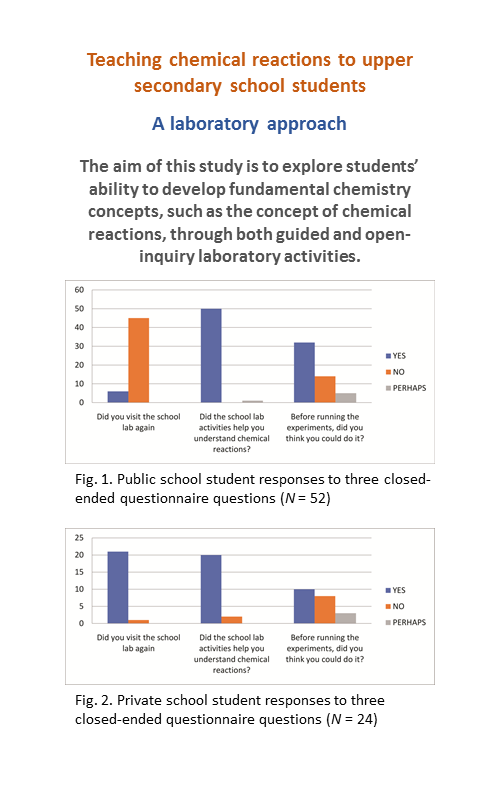
This study investigates the performance of upper secondary school students in the unit of chemical reactions following the implementation of a laboratory course in the context of the new Greek Chemistry Curriculum. The teaching intervention was run as a pilot program amongst 21 students and after the evaluation of the preliminary results, to another 76 students who were the final sample. Our findings show that most students who followed this laboratory course, were actively involved in the study of chemical reactions irrespectively of their performance in the school chemistry course. Students’ overall school performance only played a role in the process of completing the chemical equations. Most of the students developed a solution strategy in the open inquiry stage. All students were enthusiastic with the teaching strategy employed in this teaching intervention and had a positive response when asked if they have a better understanding of chemical reactions.
Downloads
Metrics
Article Details

This work is licensed under a Creative Commons Attribution 4.0 International License.

Authors retain copyright and grant the journal right of first publication with the work simultaneously licensed under a Creative Commons Attribution license 4.0 that allows others to share the work with an acknowledgement of the work's authorship and initial publication in this journal.




References
A. H. Johnstone, J. Chem. Educ. 70 (1993) 701 (https://doi.org/10.1021/ed070p701)
J. K. Gilbert, D. F. Treagust, Multiple Representations in Chemical Education, Springer Science+Business Media B.V., Cham, 2009, 4, p.1 (https://doi.org/10.1007/978-1-4020-8872-8)
A. L. Chandrasegara, D. Treagust, M. Mocerino, Chem. Educ. Res. Pract. 8 (2007) 293 (https://doi.org/10.1039/B7RP90006F)
A. Laugier, A. Dumon, Chem. Educ. Res. Pract. 5 (2004) 327 (https://doi.org/10.1039/B4RP90030H)
L. Z. Jaber, S. Boujaoude, Int. J. Sci. Educ. 34 (2011) 973 (https://doi.org/10.1080/09500693.2011.569959)
M. Cheng, J. Gilbert, Int. J. Sci. Educ. 39 (2017) 1173 (https://doi.org/10.1080/09500693.2017.1319989)
G. Tsaparlis, Chem. Educ. Res. Pract. 4 (2003) 31 (https://doi.org/10.1039/B2RP90035A)
H. Stavridou, C. Solomonidou, Int. J. Sci. Educ. 20 (1998) 205 (https://doi.org/10.1080/0950069980200206)
P. Maier, G. Klinker, in Proceedings of 2nd Experiment@ International Conference, 2013, Coimbra, Portugal, 2013, pp. 1–2 (https://doi.org/10.1109/ExpAt.2013.6703055)
R. M. Kelly, Educ. Quim. 28 (2017) 181 (https://doi.org/10.1016/j.eq.2017.02.003)
Institute of Educational Policy of Greece, http://iep.edu.gr/el/nea-ps-provoli
Institute of Educational Policy of Greece, http://iep.edu.gr/el/orologia-programmata-protovathmias-kai-defterovathmias-ekpaidefsis-2023-2024
Association of Greek Chemists, Analytical Chemistry Study Programs (https://www.esos.gr/sites/default/files/articles-legacy/analytica_programmata_xhmeias.pdf) (in Greek)
G. Orosz, V. Németh, L. Kovács, Z. Somogyi, E. Korom, Chem. Educ. Res. Pract. 24 (2022) 50 (https://doi.org/10.1039/D2RP00110A)
G. Tsaparlis, in International Perspectives on Chemistry Education Research and Practice, ACS, ACS Publications, Washington DC, 2018, p. 93 (https://doi.org/10.1021/bk-2018-1293.ch007)
A. Laugier, A. Dumon, Chem. Educ. Res. Pract. 1 (2000) 61 (https://doi.org/10.1039/A9RP90007A)
K. Taber, Chem. Educ. Res. Pract. 2 (2001) 123 (https://doi.org/10.1039/B1RP90014E)
National Research Council, Inquiry and the National Science Education Standards, A Guide for Teaching and Learning, National Academy Press, Washington DC, 2000, p. 11 (https://doi.org/10.17226/9596)
European Commission, Community Research: Science Education NOW: A renewed Pedagogy for the Future of Europe (https://www.eesc.europa.eu/sites/default/files/resources/docs/rapportrocardfinal.pdf)
A. Hofstein, Chem. Educ. Res. Pract. 5 (2004) 247 (https://doi.org/10.1039/B4RP90027H)
T. Wang, W. Wang, J. Wei, J. Chem. Educ. 99 (2022) 3954 (https://doi.org/10.1021/acs.jchemed.2c00334)
P. Bernard, K. Dudek-Różycki, K. Orwat, J. Balt. Sci. Educ. 18 (2019) 184 (https://doi.org/10.33225/jbse/19.18.184)
I. Rodríguez-Arteche, M. Martínez-Aznar, J. Chem. Educ. 93 (2016) 1528 (https://doi.org/10.1021/acs.jchemed.5b01037)
K. Taber, Foundations Chemistry 23 (2021) 433 (https://doi.org/10.1007/s10698-021-09405-8)
N. Reid, The Johnstone triangle. The key to understanding chemistry, Royal Society of Chemistry, Cambridge, 2021, p. 89 (https://science-education-research.com/advances-in-chemistry-education/the-johnstone-triangle)
P. Kirschner, J. Sweller, R. Clark, Educ. Psychol. 41 (2006) 75 (https://doi.org/10.1207/s15326985ep4102_1)
D. Smithenry, Int. J. Sci. Educ. 32 (2010) 1689 (https://doi.org/10.1080/09500690903150617)
M. Oliver, M. Romero-Ariza, A. Quesada, A. Abril, P. Sorensen, Eurasia J. Math., Sci. Tech. Ed. 16 (2020) 1793 (https://doi.org/10.29333/ejmste/109658)
A. Bryman, Social Research Methods, 2nd ed., Oxford University Press, Oxford, 2004, p.145 (ISBN 0199264465, 9780199264469)
D. Rosenthal, M. Sanger, Chem. Educ. Res. Pract. 13 (2012) 471 (https://doi.org/10.1039/C2RP20048A)
R. M. Kelly, J. H. Barrera, S. C. Mohamed, J. Chem. Educ. 87 (2009) 113 (https://doi.org/10.1021/ed800011a).