Theoretical and experimental prediction of corrosion inhibition efficiency of isatin and its derivatives by DFT calculations and weight loss method – A comparative study Scientific paper
Article Sidebar
Main Article Content
Abstract
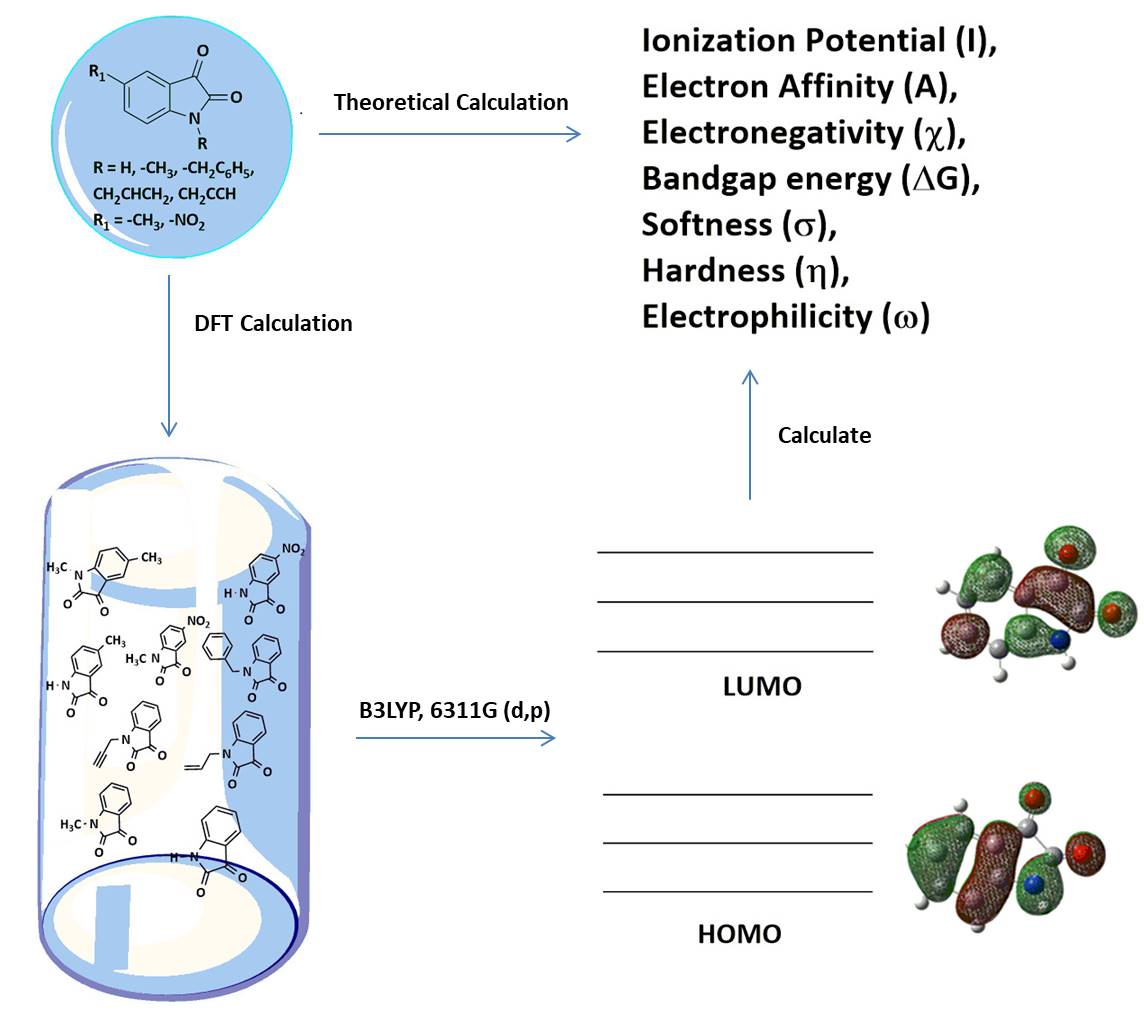
The corrosion inhibition performance of isatin and its N1/C5 substituted derivatives were analyzed by DFT calculation (B3LYP, 6311g, dp) in gas phase and solvation method with the help of Gaussian 09W and Gaussian 16. The calculated quantum chemical parameters such as ELUMO, EHOMO, ionization potential (I), electron affinity (A), electronegativity (χ), band gap energy (ΔE), softness (σ), hardness (η) and electrophilicity (ω), proved that isatin and its derivatives have the tendency to donate the electrons to the surface of metal ion on adsorption. The number of electron transfer (∆N) from isatin and its derivatives to iron metal was calculated theoretically and was in following order IX>III>VII>IV>II>V>I>VIII>VI. The experimental studies reveal the same order of inhibition as in theoretical studies. Mulliken’s charge distribution analysis of the same compounds indicates the high negative magnitude on N1 atom. The negative magnitude of N1 atom was altered by substitution in N1 and C-5 position of isatin, which was identified theoretically. Fukui local parameters were also calculated and used in the prediction of the compounds local selectivity.
Downloads
Metrics
Article Details

This work is licensed under a Creative Commons Attribution 4.0 International License.

Authors retain copyright and grant the journal right of first publication with the work simultaneously licensed under a Creative Commons Attribution license 4.0 that allows others to share the work with an acknowledgement of the work's authorship and initial publication in this journal.




References
H. Tandon, T. Chakraborthy, V. Suhag, Res. Med. Eng. Sci. 7 (2019) 792 (https://crimsonpublishers.com/rmes/pdf/RMES.000668.pdf)
M. Raftani, T. Abram, N. Bennani, M. Bouachrine, Res. Chem. 2 (2020) 100040 (https://dx.doi.org/10.1016/j.rechem.2020.100040)
H. Jouypazadeh, H. Farrokhpour, M. M. Momeni, Surf. Inter. 26 (2021) 101379 (https://dx.doi.org/10.1016/j.surfin.2021.101379)
J. Xu, Q. Wan, M. Anpo, S. Lin, J. Phys. Chem., C 124 (2020) 6624 (https://dx.doi.org/10.1021/acs.jpcc.9b11385)
Z.-Y. Liu, D. Wang, D.-T. Li, H.-Q. Wang, Comput. Theor. Chem. 1214 (2022) 113759 (https://dx.doi.org/10.1016/j.comptc.2022.113759)
S. Erdogan, Z. S. Safi, S. Kaya, D. O. Isın, L. Guo, C. Kaya, J. Mol. Struct. 1134 (2017) 751 (https://dx.doi.org/10.1016/j.molstruc.2017.01.037)
S. Perumal, S. Muthumanickam, A. Elangovan, R. Karthik, R. Sayee kannan, K. K. Mothilal, J Bio Tribo Corros. 3 (2017) 13 (https://dx.doi.org/10.1007/s40735-017-0072-5)
S. Muthumanickam, B. Jeyaprabha, R. Karthik, A. Elangovan, P. Prakash, Int. J. Corros. Scale Inhib. 4 (2015) 365 (https://dx.doi.org/10.17675/2305-6894-2015-4-4-6)
S. Perumal, S. Muthumanickam, A. Elangovan, N. Muniyappan, R. Sayee Kannan, K. Krishnamoorthi, Lett. Appл. Nanobiosci. 13 (2024) 12 (https://doi.org/10.33263/LIANBS131.012)
K. O. Sulaiman, A. T. Onawole, Comput. Theor. Chem. 1093 (2016) 73 (https://dx.doi.org/10.1016/j.comptc.2016.08.014)
M. Pitchaipillai, K. Raj, J. Balasubramanian, P. Periakaruppan, Int. J. Miner. Metall. Mater. 21 (2014) 1083 (https://dx.doi.org/10.1007/s12613-014-1013-7)
R. Karthik, P. Muthukrishnan, S.-M. Chen, B. Jeyaprabha, P. Prakash, Int. J. Electrochem. Sci. 10 (2015) 3707 (https://doi.org/10.1016/S1452-3981(23)06573-2)
I. B. Obot, A. Meroufel, I. B. Onyeachu, A. Alenazi, A. A. Sorour, J. Mol. Liq. 296 (2019) 111760 (https://dx.doi.org/10.1016/j.molliq.2019.111760)
L. M. De Andrade, C. Paternoster, P. Chevallier, S. Gambaro, P. Mengucci, D. Mantovani, Bioact. Mater. 11 (2022) 166 (https://doi.org/10.1016/j.bioactmat.2021.09.026)
L. K. M. O. Goni, M. A. J. Mazumder, M. A. Quraishi, M. M. Rahman, Chem. Asian J. 16 (2021) 1324 (https://dx.doi.org/10.1002/asia.202100201)
S. Z. Salleh, A. H. Yusoff, S. K. Zakaria, M. A. A. Taib, A. A. Seman, M. N. Masri, M. Mohamad, S. Mamat, S. A. Sobri, A. Ali, P. T. Teo, J. Clean. Prod. 304 (2021) 127030 (https://dx.doi.org/10.1016/j.jclepro.2021.127030)
N. Hossain, M. A. Chowdhury, M. Kchaou, J. Adh. Sci. Technol. 35 (2021) 673 (https://dx.doi.org/10.1080/01694243.2020.1816793)
L. Chen, D. Lu, Y. Zhang, Materials 15 (2022) 2023 (https://dx.doi.org/10.3390/ma15062023)
A. Kadhim, A. A. Al-Amiery, R. Alazawi, M. K. S. Al-Ghezi, R. H. Abass, Int. J. Corros. Scale Inhib. 10 (2021) 54 (https://dx.doi.org/10.17675/2305-6894-2021-10-1-3)
Q. Yuan, R. Cheng, S. Zou, C. Ding, H. Liu, Y. Wang, D. Yang, X. Xiao, Q. Jiang, R. Tang, J. Chen, J. Mater. Res. Technol. 9 (2020) 11935 (https://dx.doi.org/10.1016/j.jmrt.2020.08.012)
K. R. Ansari, M. A. Quraishi, J. Taiwan Inst. Chem. Eng. 54 (2015) 145 (https://dx.doi.org/10.1016/j.jtice.2015.03.013)
G. Chen, H.-J. Su, Y.-P. Song, Y. Gao, J. Zhang, X.-J. Hao, J.-R. Zhao, Res. Chem. Intermed. 39 (2013) 3669 (https://dx.doi.org/10.1007/s11164-012-0870-9)
Y. Kharbach, F. Z. Qachchachi, A. Haoudi, M. Tourabi, A. Zarrouk, C. Jama, L. O. Olasunkanmi, E. E. Ebenso, F. Bentiss, J. Mol. Liq. 246 (2017) 302 (https://dx.doi.org/10.1016/j.molliq.2017.09.057)
D. K. Verma, R. Sahu, E. Berdimurodov, C. Verma, M. A. Quraishi, V. K. Jain, K. Berdimuradov, J. Mol. Struct. 1294 (2023) 136313 (https://dx.doi.org/10.1016/j.molstruc.2023.136313)
A. A. Altalhi, Int. J. Electrochem. Sci. 19 (2024) 100449 (https://dx.doi.org/10.1016/j.ijoes.2023.100449)
H. A. El-Ghamry, A. Fawzy, T. A. Farghaly, T. M. Bawazeer, N. Alqarni, F. M. Alkhatib, M. Gaber, Arab. J. Chem. 15 (2022) 103522 (https://dx.doi.org/10.1016/j.arabjc.2021.103522)
H. M. A. El-Lateef, Appl. Surf. Sci. 501 (2020) 144237 (https://dx.doi.org/10.1016/j.apsusc.2019.144237)
D. Ma, J. Zhao, L. Zhang, J. Huang, J. Liu, T. Ren, Mater. Chem. Phys. 307 (2023) 128163 (https://dx.doi.org/10.1016/j.matchemphys.2023.128163)
A. Al-Amiery, W. N. R. W. Isahak, W. K. Al-Azzawi, J. Mol. Struct. 1288 (2023) 135829 (https://dx.doi.org/10.1016/j.molstruc.2023.135829)
T. H. A. Hasanin, A. M. A. El Malak, S. A. M. Refaey, Egypt. J. Chem. 64 (2021) 2377 (https://dx.doi.org/10.21608/EJCHEM.2021.43225.2873)
P. Udhayakala, T. V. Rajendiran, S. Gunasekaran, J. Comp. Meth. Mol. Des. 2 (2012) 1 (https://www.scholarsresearchlibrary.com/articles/theoretical-approach-to-the-corrosion-inhibition-efficiency-of-some-pyrimidine-derivatives-using-dft-method.pdf)
L. Guo, X. Ren, Y. Zhou, S. Xu, Y. Gong, S. Zhang, Arab. J. Chem. 10 (2017) 121 (https://dx.doi.org/10.1016/j.arabjc.2015.01.005)
D. M. Mamand, T. M. K. Anwer, H. M. Qadr, Corros. Rev. 42 (2024) 1 (https://dx.doi.org/10.1515/corrrev-2022-0112)
P. Kumar, I. Soni, G. K. Jayaprakash, S. Kumar, S. Rao, R. Flores-Moreno, A. S. Sowmyashree, Inorg. Chem. Commun. 146 (2022) 110110 (https://dx.doi.org/10.1016/j.inoche.2022.110110)
H. H. Rasul, D. M. Mamad, Y. H. Azeez, R. A. Omer, K. A. Omer, Comput. Theor. Chem. 1225 (2023) 114177 (https://dx.doi.org/10.1016/j.comptc.2023.114177)
D. M. Mamand, H. M. Qadr, Corros. Rev. 41 (2023) 427 (https://dx.doi.org/10.1515/corrrev-2022-0085)
N. A. Wazzan, I. B. Obot, S. Kaya, J. Mol. Liq. 221 (2016) 579 (https://dx.doi.org/10.1016/j.molliq.2016.06.011)
B. Tuzun, Ј. Bhawsar, Arab. J. Chem. 14 (2021) 102927 (https://dx.doi.org/10.1016/j.arabjc.2020.102927)
L. Tan, J. Li, X. Zeng, Materials 16 (2023) 2148 (https://dx.doi.org/10.3390/ma16062148)
R. K. Roy, H. Hirao, J. Chem. Phys. 113 (2000) 1372. (https://doi.org/10.1063/1.481927).