Determination of antibacterial properties and chemical composition of pyrolysis liquid from feeding wastes of mealworm Tenebrio molitor L. (Coleoptera: Tenebrionidae) adults and larvae Scientific paper
Article Sidebar
Main Article Content
Abstract
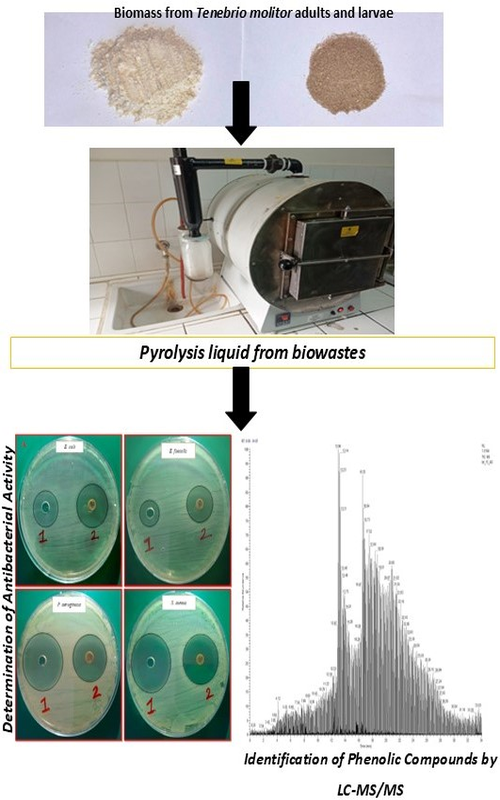
This study aimed to evaluate the antibacterial properties and phytochemical composition of pyrolysis liquids obtained from the biowaste of the mealworm Tenebrio molitor L. (Coleoptera: Tenebrionidae) adults and larvae. Biowaste was subjected to pyrolysis at 295 ± 5 °C for 7 h under a nitrogen atmosphere using a laboratory-scale system equipped with a dual condensation unit to separate light and heavy fractions. The biowaste pyrolysis liquid (BPL) were purified and analysed for their chemical content using LC-MS/MS, which identified seven key phenolic compounds, with cinnamic acid being the most abundant (358.05 µg/g), followed by salicylic acid, 4-hydroxybenzoic acid, and naringenin. Notably, the most of flavonoid derivatives were either absent or below detection limits, indicating the extract’s phenolic acid-dominated profile. The antibacterial activity of BPL was assessed against two gram-negative (E. coli ATCC-25922, P. aeruginosa ATCC-27853) and two gram-positive (E. faecalis ATCC-23212, S. aureus ATCC-25923) bacterial strains using the agar well diffusion method. The results demonstrated significant antibacterial effects, particularly against S. aureus (29.5 ± 0.3 mm) and P. aeruginosa (23.5 ± 0.2 mm), followed by E. coli (21.7 ± 0.1 mm). These findings highlight the potential of insect-derived pyrolysis liquids as natural antibacterial agents, driven largely by their phenolic acid content. This study underscores the value of biowaste valorisation for developing bioactive compounds with potential applications in antimicrobial therapies.
Downloads
Metrics
Article Details

This work is licensed under a Creative Commons Attribution 4.0 International License.

Authors retain copyright and grant the journal right of first publication with the work simultaneously licensed under a Creative Commons Attribution license 4.0 that allows others to share the work with an acknowledgement of the work's authorship and initial publication in this journal.




References
K. S. Maheswari, S. Das, R. Kurapati, R. M. Baskaran, P. Mooventhan, P. K. Ghosh, Green Technologies for Sustainable Management of Invasive and Transboundary Pests, National Institute of Agricultural Extension Management (MANAGE), Hyderabad, India, 2023. ISBN: 978-93-91668-86-0.
C. Koyunoğlu, Int. J. Thermofluids 22 (2024) 100603 (https://doi.org/10.1016/j.ijft.2024.100603)
M. H. Aissaoui, A. B. H. Trabelsi, S. Abidi, K. Zaafouri, K. Haddad, F. Jamaaoui, W. Kwapinski, Biomass Convers. Bioref. 13 (2023) 8877 (https://doi.org/10.1007/s13399-021-01735-z)
S. A. Razzak, J. Anal. Appl. Pyrolysis 181 (2024) 106622 (https://doi.org/10.1016/j.jaap.2024.106622)
A. van Huis, Ann. Rev. Entomol. 58 (2013) 563 (https://doi.org/10.1146/annurev-ento-120811-153704)
D. Mohan, C. U. Pittman Jr, P. H. Steele, Energy & Fuels 20 (2006) 848 (https://doi.org/10.1021/ef0502397)
A. V. Bridgwater, Biomass Bioenergy 38 (2012) 68 (https://doi.org/10.1016/j.biombioe.2011.01.048)
I. Gülçin, E. Bursal, M. H. Şehitoğlu, M. Bilsel, A. C. Gören, Food Chem. Toxicol. 48 (2010) 2227 (https://doi.org/10.1016/j.fct.2010.05.053)
M. Daglia, Curr. Opin. Biotechnol. 23 (2012) 174 (https://doi.org/10.1016/j.copbio.2011.08.007)
R. Suryani, W.A. Rizal, D.J. Prasetyo, W. Apriyana, M. Anwar, S.K. Wahono, Trends Sci. 20 (2023) 4985. (https://doi.org/10.48048/tis.2023.4985)
A. Demirbas, J. Anal. Appl. Pyrolysis 72 (2004) 243 (https://doi.org/10.1016/j.jaap.2004.07.003)
K. C. Surendra, R. Olivier, J. K. Tomberlin, R. Jha, S. K. Khanal, Renew. Energy 98 (2016) 197 (https://doi.org/10.1016/j.renene.2016.03.022)
D. Patón, J. C. García-Gómez, J. Loring, A. Torres, Waste Biomass Valor. 14 (2023) 167 (https://doi.org/10.1007/s12649-022-01849-z)
Z. Breijyeh, B. Jubeh, R. Karaman, Molecules 25 (2020) 1340 (https://doi.org/10.3390/molecules25061340)
M. A. Yilmaz, Ind. Crops Prod. 149 (2020) 112347 (https://doi.org/10.1016/j.indcrop.2020.112347)
Ö. Karpuz, C. Baltacı, A. Gül, J. Gülen, P. Bozbeyoğlu, N. Aydoğan, Biomass Convers. Bioref. (2024) (https://doi.org/10.1007/s13399-024-06287-6)
Y. Y. Zhang, K. Thakur, C. K. Wei, H. Wang, J. G. Zhang, Z. J. Wei, S. Afr. J. Bot. 120 (2019) 179 (https://doi.org/10.1016/j.sajb.2018.05.002)
R. Razavi, R. Molaei, M. Moradi, H. Tajik, P. Ezati, A. Shafipour Yordshahi, Appl. Nanosci. 10 (2020) 465 (https://doi.org/10.1007/s13204-019-01137-8)
S.A. Ansari, T. Kumar, R. Sawarkar, M. Gobade, D. Khan, L. Singh, J. Environ. Manage. 364 (2024) 121439. (https://doi.org/10.1016/j.jenvman.2024.121439).
A.T. Ubando, C.B. Felix, W.H. Chen, Bioresour. Technol. 299 (2020) 122585 (https://doi.org/10.1016/j.biortech.2019.122585)
A. Kapoor, M. Raghunathan, B. Lal, P. Kumar, N. Srivastava, G.L. Devnani, D.B. Pal, Chemosphere (2024) 143279 (https://doi.org/10.1016/j.chemosphere.2024.143279).