
Dissipation kinetics of boscalid and pyraclostrobin in strawberries: Implications for pre-harvest intervals and residue management
Article Sidebar
Main Article Content
Abstract
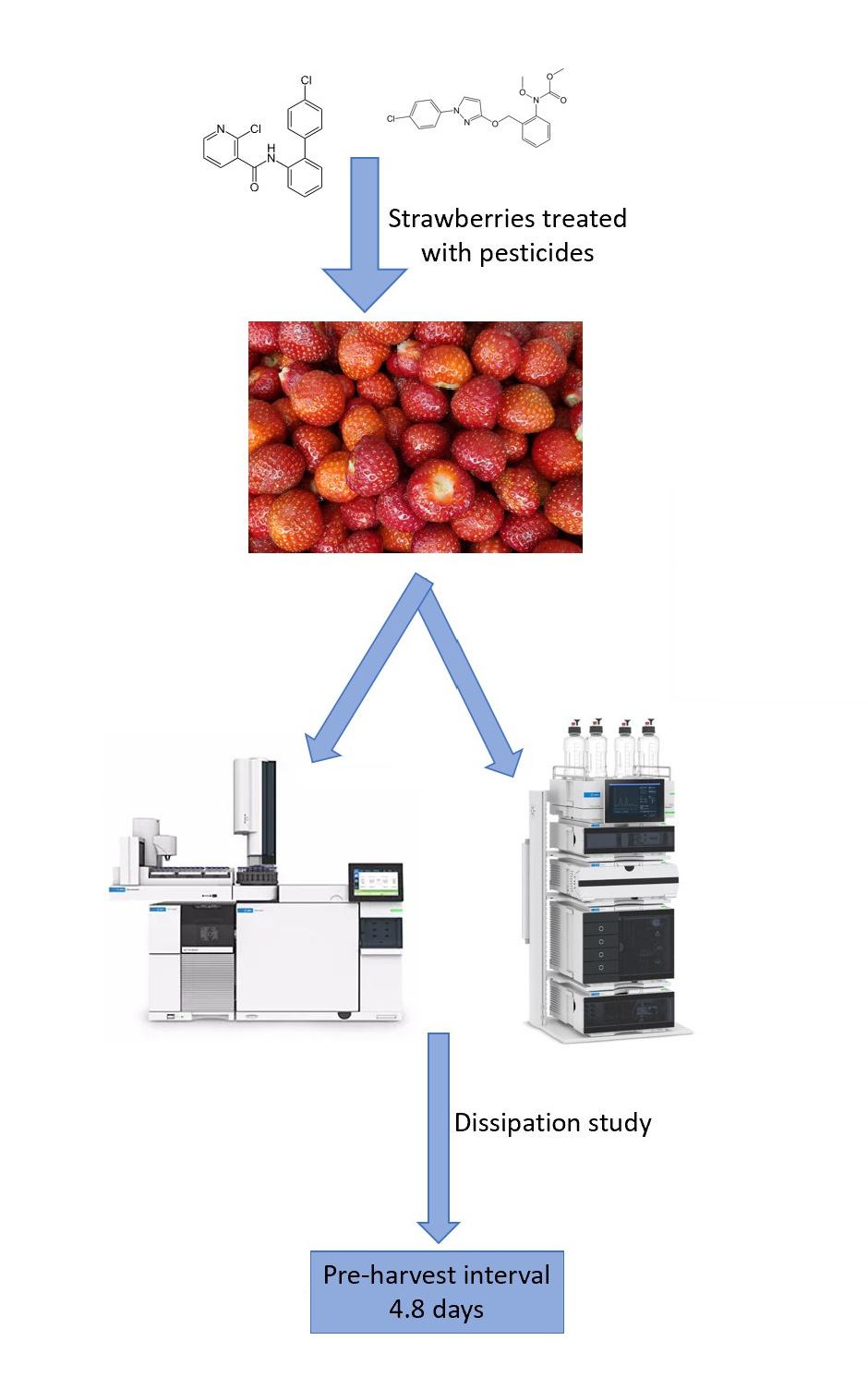
This study investigated the dissipation kinetics of the fungicides boscalid and pyraclostrobin in strawberries under field conditions. Residue analyses were performed using a validated modified QuEChERS extraction followed by GC–MS and HPLC-DAD quantification. Boscalid and pyraclostrobin exhibited half-lives of 3.89 and 2.40 days, respectively, indicating low persistence and first-order kinetic behavior. These results are in good agreement with previous studies in berry fruits and other crops, highlighting the influence of environmental factors such as temperature, solar radiation, and fruit surface characteristics on pesticide degradation. Pre-harvest intervals (PHIs) calculated from the regression models were 4.8 days for boscalid and 2.7 days for pyraclostrobin, supporting compliance with EU maximum residue limits. The findings confirm the reliability of the analytical method and provide valuable data for regulatory monitoring, dietary risk assessment, and sustainable pesticide management in soft fruit production.
Downloads
Article Details

This work is licensed under a Creative Commons Attribution 4.0 International License.

Authors retain copyright and grant the journal right of first publication with the work simultaneously licensed under a Creative Commons Attribution license 4.0 that allows others to share the work with an acknowledgement of the work's authorship and initial publication in this journal.




Funding data
-
Agentúra na Podporu Výskumu a Vývoja
Grant numbers SK-SRB-23-0020 -
Vedecká Grantová Agentúra MŠVVaŠ SR a SAV
Grant numbers No. 1/0332/24 -
Slovenská technická univerzita v Bratislave
Grant numbers ENVIGREEN project
References
F. Giampieri, S. Tulipani, J. M. Alvarez-Suarez, J. L. Quiles, B. Mezzetti, M. Battino, Nutrition 28 (2012) 9–19 (https://doi.org/10.1016/j.nut.2011.08.009)
FAO FAOSTAT: Crops and livestock products. Food and Agriculture Organization of the United Nations (2024a)
Republic of Turkey: General Directorate of Food and Control (GKGM) Plant protection guidelines for strawberry cultivation (2019)
J. Fenik, M. Tankiewicz, M. Biziuk, TrAC Trends in Analytical Chemistry 30 (2011) 814–826 (https://doi.org/10.1016/j.trac.2011.02.008)
A. Leskovac, S. Petrović, Foods 12 (2023) 2709 (https://doi.org/10.3390/foods12142709)
H. Cavalier, L. Trasande, M. Porta, Int. J. Can. 152 (2023) 879–912 (https://doi.org/10.1002/ijc.34300)
European Comission: Regulation (EC) No 396/2005 of the European Parliament and of the Council on maximum residue levels of pesticides in or on food and feed of plant and animal origin. Official Journal of the European Union, L70, 1–16 (2006)
European Food Safety Authority: Pesticide residue monitoring in food: 2023 annual report. EFSA Journal, 21(5), e07980 (2023)
European Commission: RASFF (Rapid Alert System for Food and Feed): Annual report on notifications 2023 (2024)
D. W. Bartlett, J. M. Clough, J. R. Godwin, A. A. Hall, M. Hamer, B. Parr‐Dobrzanski, Pest. Manage. Sci. 58 (2002) 649–662 (https://doi.org/10.1002/ps.520)
G. Stammler, H. D. Brix, A. Glattli, M. Semar, U. Schoefl, Biological properties of the carboxamide boscalid including recent studies on its mode of action, 16th International plant protection congress, Glasgow, Scotland British Crop Protection Council, Alton (2007), 40–45, (https://www.tib.eu/en/search/id/BLCP:CN066689114/Biological-properties-of-the-carboxamide-boscalid/)
P. Fantke, R. Juraske, Environ. Sci. Technol. 47 (2013) 3548–3562 (https://doi.org/10.1021/es303525x)
1. M. Anastassiades, S. J. Lehotay, D. Stajnbaher, F. J. Schenck, J AOAC Int. 86 (2003) 412–431 (https://pubmed.ncbi.nlm.nih.gov/12723926/)
S. J. Lehotay, M. O. Neil, J. Tully, J. AOAC Int. 90 (2007) 485–520 (https://doi.org/10.1093/jaoac/90.2.485)
European Committee for Standardization (CEN) Standard Method EN 15662 (2009)
Analytical Quality Control And Method Validation Procedures For Pesticide Residues Analysis In Food And Feed Sante 11312/2021 V2, https://food.ec.europa.eu/system/files/2023-11/pesticides_mrl_guidelines_wrkdoc_2021-11312.pdf, (September 15, 2025)
Republic Hydrometeorological Service of Serbia (RHSS) (2024). Meteorological yearbook 1: Climatological data 2024, Belgrade.
D. Šunjka, S. Lazić, S. Vuković, A. Alavanja, Đ. Nađ, S. Mitrić, Plant Prot. Sci. 57 (2021) 326–332 (https://doi.org/10.17221/154/2020-PPS)
G. K. Pandit, G. S. Krushna, N. Chowdhury, J. Ghosh, Pesticide Res. J. 28(1) (2016) 20–24 (https://www.indianjournals.com/article/prj-28-1-003)
O. Abdallah, S. Abdel Ghani, S. Hrouzková, J. Liq. Chrom. Rel. Technol. 40 (2017) 392–399 (https://doi.org/10.1080/10826076.2017.1310112)
M. Jankowska, P. Kaczynski, I. Hrynko, B. Lozowicka, Environ. Sci. Pollut. Res. 23 (2016) 11885–11900 (https://doi.org/10.1007/s11356-016-6260-x)
S. Sadło, B. Piechowicz, M. Podbielska, E. Szpyrka, Environ. Sci. Pollut. Res. 25 (2018) 8057–8068 (https://doi.org/10.1007/s11356-017-1098-4)
L. Chen, S. Zhang, Bull. Environ. Contam. Toxicol. 84 (2010) 301–304 (https://doi.org/10.1007/s00128-010-9934-y)
A. Oriby, F. Sdeek, I. Ismail, M. Ramadan, A. Ali, Egypt. J. Chem. 0 (2023) 0–0 (https://doi.org/10.21608/ejchem.2023.222580.8248)
L. Lv, Y. Su, B. Dong, W. Lu, J. Hu, X. Liu, Molecules 27 (2022) 4410 (https://doi.org/10.3390/molecules27144410)
M. Jankowska, P. Kaczyński, B. Łozowicka, Pest Manag. Sci. 77 (2021) 3349–3357 (https://doi.org/10.1002/ps.6379)
X. Chen, S. He, Y. Gao, Y. Ma, J. Hu, X. Liu, Food Chem. 274 (2019) 291–297 (https://doi.org/10.1016/j.foodchem.2018.08.136).