The effect of catalyst composition and surface properties on the selective catalytic dehydrogenation of bioethanol Scientific paper
Article Sidebar
Main Article Content
Abstract
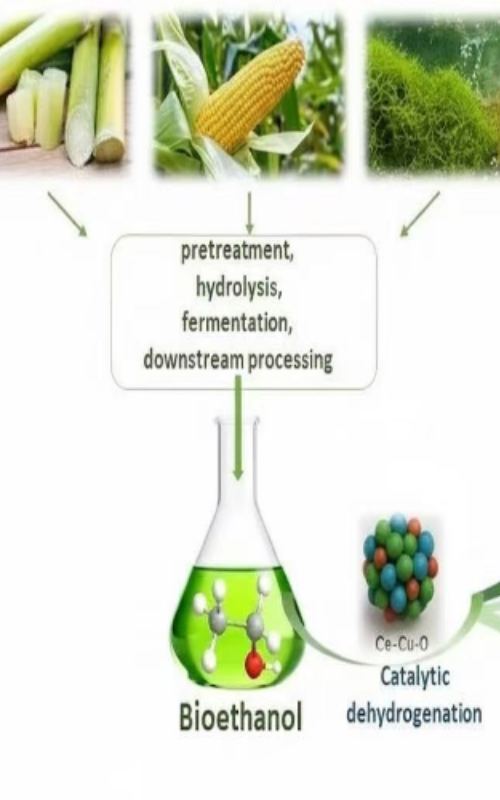
The article provides a comparative analysis of bioethanol dehydrogenation using Cr–Cu–O and Ce–Cu–O catalyst systems. For the Cr–Cu–O catalysts, bioethanol is converted into a range of products including acetaldehyde, acetone and ethylene. Advanced characterization revealed that these catalysts are structurally complex, containing not only individual copper and chromium oxides but also a distinct compound, Cu2CrO4. A key finding is the clear structure–property relationship: the catalyst’s crystallinity, which varied widely from 41.9 (mostly amorphous) to 73.8 % (highly crystalline), has a major effect on its catalytic activity. The Ce–Cu–O system converted bioethanol into a diverse mixture of products such as acetaldehyde, acetone and ethyl acetate, indicating the occurrence of multiple simultaneous reactions, including dehydrogenation and condensation. Most compositions resulted in separate CeO2 and CuO phases; however, a specific Ce:Cu ratio of 1:9 is unique. At this ratio, the material is reduced to form CeO2 with elemental copper, rather than CuO, and its crystallinity increased from 52.7 to 71.2 %. The research showed that structural order is crucial for steering the reaction pathway, as only catalysts with low crystallinity produce ethyl acetate. Furthermore, while the specific surface area of a catalyst (5.0 to 17.0 m2/g in this study) is a key factor in surface-driven reactions such as dehydrogenation, it does not affect all products equally.
Downloads
Metrics
Article Details

This work is licensed under a Creative Commons Attribution 4.0 International License.

Authors retain copyright and grant the journal right of first publication with the work simultaneously licensed under a Creative Commons Attribution license 4.0 that allows others to share the work with an acknowledgement of the work's authorship and initial publication in this journal.




References
M. A. K. Joyia, M. Ahmad, Y. F. Chen, M. Mustaqeem, A. Ali, A. Abbas, M. A. Gondal, Energy Convers. Manage. 321 (2024) 119037 (https://doi.org/10.1016/j.enconman.2024.119037)
S. Jain, S. Kumar, Energy 296 (2024) 131130 (https://doi.org/10.1016/j.energy.2024.131130)
A. S. Dibazar, A. Aliasghar, A. Behzadnezhad, A. Shakiba, M. Pazoki, Biomass Convers. Biorefin. 14 (2024) 20679 (https://doi.org/10.1007/s13399-023-04288-5)
K. Mihajlovski, M. Milić, D. Pecarski, S. Dimitrijević-Branković, J. Serb. Chem. Soc. 86 (2021) 651 (https://doi.org/10.2298/JSC210308032M)
M. H. Morad, Arab. J. Chem. 17 (2024) 105560 (https://doi.org/10.1016/j.arabjc.2023.105560)
E. S. Mamedov, B. A. Babaeva, S. E. Mamedov, N. F. Akhmedova, F. S. Kerimli, Moscow Univ. Chem. Bull. 77 (2022) 222 (https://doi.org/10.3103/S002713142204006X)
I. M. S. Anekwe, B. Oboirien, Y. M. Isa, Biofuels, Bioprod. Bioref. 18 (2024) 686 (https://doi.org/10.1002/bbb.2536)
B. Thangaraj, W. Monama, E. Mohiuddin, M. M. Mdleleni, Bioresour. Technol. 409 (2024) 131230 (https://doi.org/10.1016/j.biortech.2024.131230)
R. Lei, Z. Chen, Q. Xu, N. Wang, Y. Qin, T. Wang, X. Lin, X. Qiu, Green Chem. 27 (2025) 9643 (https://doi.org/10.1039/D5GC02486B)
G. Busca, E. Spennati, P. Riani, T. K. Phung, G. Garbarino, J. Environ. Chem. Eng. 13 (2025) 119648 (https://doi.org/10.1016/j.jece.2025.119648)
S. Liu, Y. Meng, C. Luo, H. Zhu, Y. Song, H. Zhang, T. Wu, Int. J. Hydrogen Energy 86 (2024) 1414 (https://doi.org/10.1016/j.ijhydene.2024.08.413)
P. G. Choi, T. Ohno, T. Masui, N. Imanaka, J. Environ. Sci. 36 (2015) 63 (https://doi.org/10.1016/j.jes.2015.04.017)
D. Yu, W. Dai, G. Wu, N. Guan, L. Li, Chin. J. Catal. 40 (2019) 1375 (https://doi.org/10.1016/S1872-2067(19)63378-4)
C. Autthanit, W. Chatkaew, P. Praserthdam, B. Jongsomjit, J. Environ. Chem. Eng. 8 (2020) 103547 (https://doi.org/10.1016/j.jece.2019.103547)
W. Tian, B. Jongsomjit, D. Pjontek, J. E. Herrera, Mol Catal. 483 (2020) 110717 (https://doi.org/10.1016/j.mcat.2019.110717)
A. Singh, G. P. Rangaiah, Ind. Eng. Chem. Res. 56 (2017) 5147 (https://doi.org/10.1021/acs.iecr.7b00273)
F. Fang, Y. Guo, Chin. J. Catal. 39 (2018) 566 (https://doi.org/10.1016/s1872-2067(17)62996-6)
P. H. Finger, T. A. Osmari, M. S. Costa, J. M. C. Bueno, J. M. R. Gallo, Appl. Catal., A 589 (2020) 117236 (https://doi.org/10.1016/j.apcata.2019.117236)
S. H. Mammadova, K. X. Aghayeva, Chem. Prob. 18 (2020) 199 (https://chemprob.org/wp-content/uploads/2025/10/199-206.pdf)
A. Makoye, A. Vikar, A. B. Nacsa, R. Barthos, J. Valyon, F. Lónyi, T. Nagy, Catalysts 15 (2025) 709 (https://doi.org/10.3390/catal15080709)
M. Ngcobo, P. R. Makgwane, M. K. Mathe, Appl. Catal. Open 193 (2024)193 206976 (https://doi.org/10.1016/j.apcato.2024.206976)
S. Said, M. Riad, J. Phys. Chem. Sol. 205 (2025) 112789 (https://doi.org/10.1016/j.jpcs.2025.112789)
C. Tian, Y. Yue, C. Miao, W. Hua, Z. Gao, Catalysts 14 (2024) 541 (https://doi.org/10.3390/catal14080541)
Y. Zhang, Y. Wang, X. Guan, H. Li, X. Nie, Y. Liang, X. Bao, X. Li, F. Wang, J. Catal. 426 (2023) 86 (https://doi.org/10.1016/j.jcat.2023.06.030)
Y. A. Fionov, S. G. Chuklina, K. S. Khlusova, A. V. Fionov, A. I. Zhukova, Magn. Reson. Chem. 61 (2023) 427 (https://doi.org/10.1002/mrc.5353)
C. K. F. Monguen, S. Daniel, Z. Y. Tian, Chem. Eng. J. 474 (2023) 145769 (https://doi.org/10.1016/j.cej.2023.145769)
S. Preedavijitkul, C. Autthanit, S. Jadsadajerm, C. Sricharoen, P. Praserthdam, B. Jongsomjit, J. Taiwan Inst. Chem. Eng. 147 (2023) 104895 (https://doi.org/10.1016/j.jtice.2023.104895).