Sustainable remediation of olive mill wastewater: Phenolic compound removal using rice husk-derived nanosilica and sodium silicate
Article Sidebar
Main Article Content
Abstract
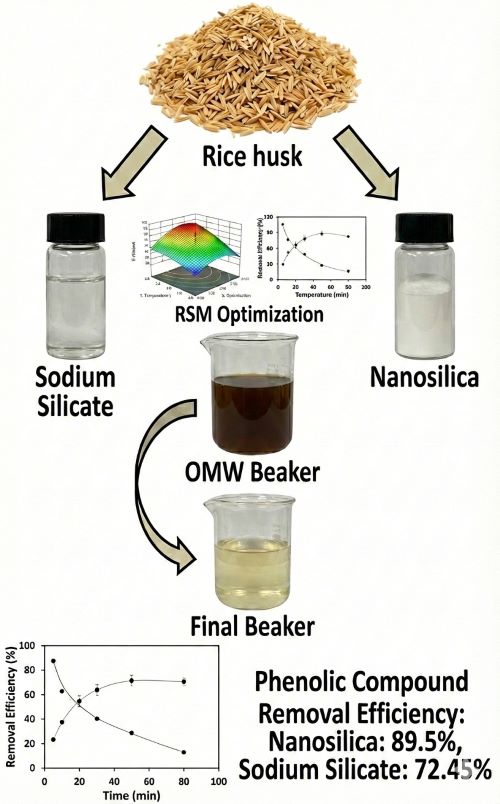
This study investigates the remediation of olive mill wastewater (OMW) using nanosilica and sodium silicate extracted from rice husk. Characterized by FTIR, UV-Visible spectroscopy, and particle size analysis, these sustainable adsorbents were evaluated for the removal of phenolic compounds. Response Surface Methodology (RSM) was employed to optimize batch adsorption parameters, including concentration, mixing time, and rotational speed. Nanosilica demonstrated superior performance, achieving a maximum adsorption capacity of 1024.9 mg/g and 89.979% removal efficiency under optimal conditions (0.5% concentration, 15 min, 200 rpm). In comparison, sodium silicate yielded a capacity of 130.68 mg/g and 72.45% removal (2% concentration, 52.5 min, 300 rpm). Furthermore, kinetic and isotherm models were applied to describe the adsorption mechanisms. Mechanistic investigations utilizing the Weber-Morris model established that adsorption is controlled by a multi-step sequence of film and intra-particle diffusion, with nanosilica demonstrating a remarkably higher intra-particle diffusion rate (Kid = 18.879 mg g-1min-0.5). Furthermore, thermodynamic parameters (∆G < 0) and the Dubinin–Radushkevich isotherm (E < 8 kJ/mol) conclusively proved that the sequestration process is governed by spontaneous physisorption. These findings confirm the potential of rice husk-derived materials as efficient, eco-friendly adsorbents for OMW treatment.
Downloads
Metrics
Article Details

This work is licensed under a Creative Commons Attribution 4.0 International License.

Authors retain copyright and grant the journal right of first publication with the work simultaneously licensed under a Creative Commons Attribution license 4.0 that allows others to share the work with an acknowledgement of the work's authorship and initial publication in this journal.




References
S. Ijaz, A. Kausar, M. Iqbal, N. El Messaoudi, Y. Miyah, S. Knani, B. Graba, J. Water Process Eng. 71 (2025) 107187 (https://doi.org/10.1016/j.jwpe.2025.107187)
A. Jamrah, T. M. Al-Zghoul, M. M. Darwish, Case Stud. Chem. Environ. Eng. 8 (2023) 100493 (https://doi.org/10.1016/j.cscee.2023.100493)
K. O. Rocha, F. Brandão, C. Mendes, M. G. V. S. Carvalho, P. Mazierski, A. Zaleska-Medynska, J. Gomes, R. C. Martins, E. Domingues, Catal. Today 432 (2024) 114618 (https://doi.org/10.1016/j.cattod.2024.114618)
L. Al-Hmoud, B. Al-Saida, A. Sandouqa, Jordanian J. Eng. Chem. Ind. 3 (2020) 91–106 (https://doi.org/10.48103/jjeci3112020)
M. O. J. Azzam, J. Environ. Chem. Eng. 6 (2018) 2126–2136 (https://doi.org/10.1016/j.jece.2018.03.009)
M. O. J. Azzam, S. A. Hazaimeh, Process Saf. Environ. Prot. 148 (2021) 495–523 (https://doi.org/10.1016/j.psep.2020.10.030)
A. Faggiano, M. De Carluccio, A. Fiorentino, M. Ricciardi, R. Cucciniello, A. Proto, L. Rizzo, Sep. Purif. Technol. 305 (2023) 122525 (https://doi.org/10.1016/j.seppur.2022.122525)
J. R. Balbinoti, R. E. dos Santos Junior, L. B. F. de Sousa, F. de Jesus Bassetti, T. C. V. Balbinoti, L. M. de Matos Jorge, R. M. M. Jorge, J. Water Process Eng. 52 (2023) 103525 (https://doi.org/10.1016/j.jwpe.2023.103525)
S. M. T. Al-Abboodi, E. J. A. Al-Shaibani, E. A. Alrubai, IOP Conf. Ser.: Mater. Sci. Eng. 978 (2020) 012031 (https://doi.org/10.1088/1757-899x/978/1/012031)
M. Sorour, M. Helmy, A. S. EL Mahrouky, I. I. Ahmed, Food Technol. Res. J. 2 (2023) 68–72 (https://doi.org/10.21608/ftrj.2023.329291)
X. Liu, Z. Li, H. Chen, L. Yang, Y. Tian, Z. Wang, Res. Chem. Intermed. 42 (2016) 3887–3903 (https://doi.org/10.1007/s11164-015-2251-7)
Y. Cardona, S. A. Korili, A. Gil, Chem. Eng. J. 425 (2021) 130708 (https://doi.org/10.1016/j.cej.2021.130708)
A. Yangui, M. Abderrabba, A. Sayari, J. Taiwan Inst. Chem. Eng. 70 (2017) 111–118 (https://doi.org/10.1016/j.jtice.2016.10.053)
F. Elayadi, W. Boumya, M. Achak, Y. Chhiti, F. E. M. Alaoui, N. Barka, C. El Adlouni, Environ. Challenges 4 (2021) 100184 (https://doi.org/10.1016/j.envc.2021.100184)
L. Dolatyari, M. R. Yaftian, S. Rostamnia, J. Environ. Manage. 169 (2016) 8–17 (https://doi.org/10.1016/j.jenvman.2015.12.005)
H. S. Titah, I. F. Purwanti, B. V. Tangahu, S. B. Kurniawan, M. F. Imron, S. R. S. Abdullah, N. Ismail, J. Environ. Manage. 238 (2019) 194–200 (https://doi.org/10.1016/j.jenvman.2019.03.011)
Y. Zhou, Y. Li, D. Liu, X. Wang, D. Liu, L. Xu, Colloids Surf. A Physicochem. Eng. Asp. 607 (2020) 125422 (https://doi.org/10.1016/j.colsurfa.2020.125422)
M. S. Slimani, M. Aazza, H. Ahlafi, A. El-Kordy, H. Barkouch, M. Amar, O. T. Alaoui, M. Hamidi, J. Mol. Liq. 457 (2026) 129704 (https://doi.org/10.1016/j.molliq.2026.129704)
E. Rafiee, S. Shahebrahimi, M. Feyzi, M. Shaterzadeh, Int. Nano Lett. 2 (2012) 29 (https://doi.org/10.1186/2228-5326-2-29)
V. B. Carmona, R. M. Oliveira, W. T. L. Silva, L. H. C. Mattoso, J. M. Marconcini, Ind. Crops Prod. 43 (2013) 291–296 (https://doi.org/10.1016/j.indcrop.2012.06.050)
A. Jyoti, R. K. Singh, N. Kumar, A. K. Aman, M. Kar, Mater. Sci. Eng. B 263 (2021) 114871 (https://doi.org/10.1016/j.mseb.2020.114871)
F. M. Mohamed, K. A. Alfalous, Egypt. J. Aquat. Res. 46 (2020) 131–136 (https://doi.org/10.1016/j.ejar.2020.03.004)
A. I. Biradar, P. D. Sarvalkar, S. B. Teli, C. A. Pawar, P. S. Patil, N. R. Prasad, Mater. Today Proc. 43 (2021) 2832–2838 (https://doi.org/10.1016/j.matpr.2020.11.946)
M. Sadeghi, M. Dorodian, M. Rezaei, J. Adv. Chem. 6 (2013) 917–922
A. Eslami, M. Mehralian, Z. G. Chegini, M. Khashij, Desalin. Water Treat. 108 (2018) 345–352 (https://doi.org/10.5004/dwt.2018.21966)
Y. Dehmani, L. Sellaoui, Y. Alghamdi, J. Lainé, M. Badawi, A. Amhoud, A. Bonilla-Petriciolet, T. Lamhasni, S. Abouarnadasse, J. Mol. Liq. 312 (2020) 113383 (https://doi.org/10.1016/j.molliq.2020.113383)
G. La Scalia, R. Micale, L. Cannizzaro, F. P. Marra, J. Clean. Prod. 142 (2017) 3782–3788 (https://doi.org/10.1016/j.jclepro.2016.10.086)
A. F. Al Bawab, M. A. Abu-Dalo, H. Kanaan, N. Al-Rawashdeh, F. Odeh, Water Sci. Technol. 91 (2025) 567–580 (https://doi.org/10.2166/wst.2025.007)
L. Papaoikonomou, K. Labanaris, K. Kaderides, A. M. Goula, Environ. Sci. Pollut. Res. 28 (2021) 24230–24244 (https://doi.org/10.1007/s11356-019-07277-2)
D. Bouazzi, A. Mehri, K. Kaaroud, H. Touati, F. Karouia, J. M. Clacens, A. Laghzizil, B. Badraoui, Colloids Surf. A Physicochem. Eng. Asp. 666 (2023) 131366 (https://doi.org/10.1016/j.colsurfa.2023.131366)
M. Ammari, M. Zerrouk, I. Zoufri, Y. El-Byari, A. Mazrha, F. E. Mrizak, M. Merzouki, Sci. African 27 (2025) e02612 (https://doi.org/10.1016/j.sciaf.2025.e02612)
M. Ververi, A. M. Goula, Chem. Eng. Process. Intensif. 138 (2019) 86–96 (https://doi.org/10.1016/j.cep.2019.03.010)
G. Enaime, W. El Bouaidi, M. Louarrat, A. Baçaoui, A. Yaacoubi, M. Loudiki, M. Wichern, M. Lübken, Biomass Convers. Biorefinery 15 (2025) 4153–4165 (https://doi.org/10.1007/s13399-023-05261-y)
M. B. Bahrodin, N. S. Zaidi, A. Kadier, N. Hussein, A. Syafiuddin, R. Boopathy, Appl. Sci. 12 (2022) 7972 (https://doi.org/10.3390/app12167972)
A. Kumari, M. Yadav, N. Kumar, Bull. Pure Appl. Sci. 42 (2023) 101–105 (https://doi.org/10.48165/bpas.2023.42c.2.6)
M. F. Al Rawi, G. Y. Al Kindi, J. K. Al Refaae, T. A. Hussain, H. A. Al-Haidri, IOP Conf. Ser. Earth Environ. Sci. 1222 (2023) (https://doi.org/10.1088/1755-1315/1222/1/012012)
M. A. Masmoudi, N. Abid, F. Feki, F. Karray, M. Chamkha, S. Sayadi, Euro-Mediterranean J. Environ. Integr. 9 (2024) 621–635 (https://doi.org/10.1007/s41207-024-00464-9)
Y. Zhou, Y. Li, D. Liu, D. Liu, L. Xu, C. Liu, Colloids Surf. A Physicochem. Eng. Asp. 627 (2021) 127145 (https://doi.org/10.1016/j.colsurfa.2021.127145)
S. Allaoui, RHAZES Green Appl. Chem. 6 (2019) 40–46 (https://doi.org/10.1155/2020/7293189)
S. Allaoui, M. N. Bennani, H. Ziyat, O. Qabaqous, N. Tijani, N. Ittobane, G. Hodaifa, Heliyon 7 (2021) e07525 (https://doi.org/10.1016/j.heliyon.2021.e07525).