Redox pathways in the carnosine–manganese system mediated by semiquinone radicals Scientific paper
Article Sidebar
Main Article Content
Abstract
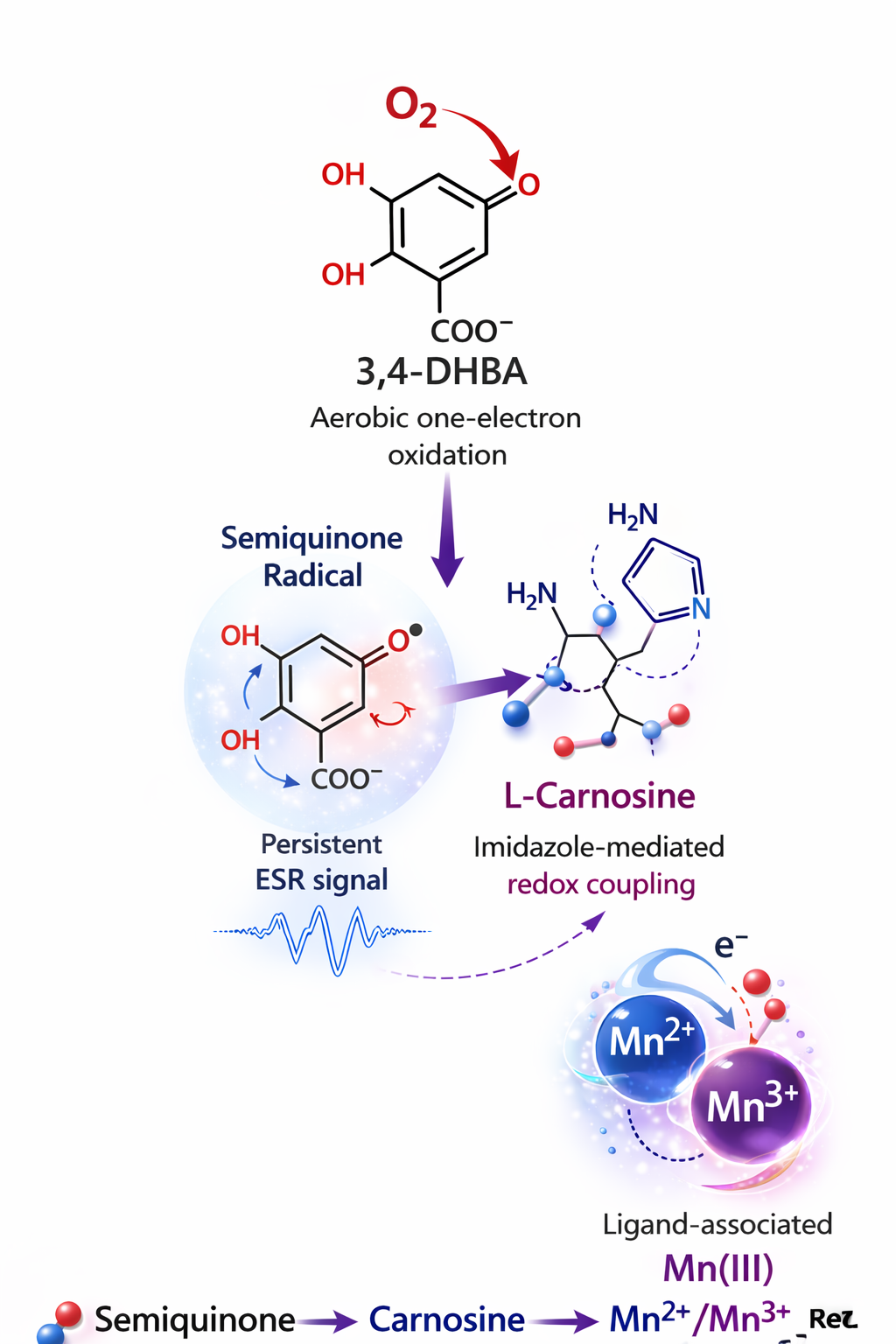
The interaction of carnosine histidine-containing dipeptide with the semiquinone radical of 3,4-dihydroxybenzoic dianion in dimethyl sulfoxide solution under aerobic conditions was investigated in the present study. The interaction of dipeptide–manganese system with the same semiquinone was also studied under the identical conditions. The metal-binding and redox chemistry of these systems were investigated using electronic, ESR, 1H-NMR spectroscopies and cyclic voltammetry. The in situ formal semiquinone radicals (extensively studied in previous works) were significantly modified upon addition of carnosine, as evidenced by the redistribution of the visible absorption bands and the change of the redox couples of the catecholic product. Subsequent influence of Mn ions induced further spectral and electrochemical changes, consistent with metal centered oxidation and formation of ligand-stabilized manganese species. Paramagnetic broadening in the 1H-NMR spectra supported the presence of higher-valent Mn intermediates in solution. The combined data support a cooperative redox pathway in which semiquinone species mediate both peptide oxidation and Mn centered electron transfer. These results provide chemical insight into the understanding of multicomponent systems usually present in nature.
Downloads
Metrics
Article Details

This work is licensed under a Creative Commons Attribution 4.0 International License.

Authors retain copyright and grant the journal right of first publication with the work simultaneously licensed under a Creative Commons Attribution license 4.0 that allows others to share the work with an acknowledgement of the work's authorship and initial publication in this journal.




References
M. Teufel, V. Saudek, J. P. Ledig, A. Bernhardt, S. Boularand, A. Carreau, N. J. Cairns, C. Carter, D. J. Cowley, D. Duverger, A. J. Ganzhorn, C. Guenet, B. Heintzelmann, V. Laucher, C. Sauvage, T. Smirnova, J. Biol. Chem. 278 (2003) 6521 (http://dx.doi.org/10.1074/jbc.M209764200)
A. Pegova, H. Abe, A. A. Boldyrev, Comp. Biochem. Physiol., B 127 (2000) 443 (http://dx.doi.org/10.1016/s0305-0491(00)00279-0)
F. Melak, M. Redi, M. Tessema, E. Alemayehu, Nature Sci. 5 (2013) 888 (http://dx.doi.org/10.4236/ns.2013.58107)
P. Wardman, J. Phys. Chem. Ref. Data 18 (1989) 1637 (http://dx.doi.org/10.1063/1.555843)
M. E. Peover, Trans. Faraday Soc. 60 (1964) 417 (http://dx.doi.org/10.1039/TF9646000417)
M. J. Davies, S. Fu, H. Wang, R. T. Dean, Free Radic. Biol. Med. 27 (1999) 1151 (http://dx.doi.org/10.1016/S0891-5849(99)00206-3)
A. B. P. Lever, Inorganic Electronic Spectroscopy, 2nd ed., Elsevier, Amsterdam, 1984
C. Bull, G. J. McClune, J. A. Fee, J. Am. Chem. Soc. 105 (1983) 5290 (http://dx.doi.org/10.1021/ja00354a019)
D. D. Perrin, Stability Constants of Metal-Ion Complexes, Pergamon Press, Oxford, 1979
E. I. Solomon, A. B. P. Lever, Inorganic Electronic Structure and Spectroscopy, Vols.
I–II, Wiley, New York, 2006
L. Que Jr., W. B. Tolman, Nature 455 (2008) 333 (http://dx.doi.org/10.1038/nature07371)
G. Bartosz, Clin. Chim. Acta 368 (2006) 53 (http://dx.doi.org/10.1016/j.cca.2005.12.039)
D. Pavlos, P. Petropouleas, D. Hatzipanayioti, Chem. Phys. 461 (2015) 63 (http://dx.doi.org/10.1016/j.chemphys.2015.08.027)
D. Pavlos, Α. Perivolaris, Pharmakeftiki 36 (2024) 61 (http://dx.doi.org/10.60988/p.v36i4.61)
P. Petropouleas, G. Koufopoulos, D. Hatzipanayioti, Spectrochim. Acta, A 94 (2012) 169 (http://dx.doi.org/10.1016/j.saa.2012.03.060)
H. C. Sutton and D. F. Sangster, J. Chem. Soc., Faraday Trans. 1 78 (1982) 695 (http://dx.doi.org/10.1039/F19827800695)
T. W. Grant, M. D. Doherty, D. Odowole, K. D. Sales, G. M. Cohen, FEBS Lett. 201 (1986) 296 (http://dx.doi.org/10.1016/0014-5793(86)80627-5)
H. Komatsuzaki, A. Shiota, S. Hazawa, M. Itoh, N. Miyamura, N. Miki, Y. Takano, J. Nakazawa, A. Inagaki, M. Akita, S. Hikichi, Chem. Asian J. 8 (2013) 1115 (http://dx.doi.org/10.1002/asia.201300029)
D. Gatteschi, A. Bencini, EPR of Exchange Coupled Systems, Springer, Berlin, 1990 (https://doi.org/10.1007/978-3-642-74599-7)
W. Nam, Acc. Chem. Res. 40 (2007) 522 (http://dx.doi.org/10.1021/ar700027f)
E. I. Solomon, A. Decker, N. Lehnert, Proc. Natl. Acad. Sci. U.S.A. 100 (2003) 3589 (http://dx.doi.org/10.1073/pnas.0336792100)
E. Berti, A. Caneschi, C. Daiguebonne, P. Dapporto, M. Formica, V. Fusi, L. Giorgi, A. Guerri, M. Micheloni, P. Paoli, R. Pontellini, P. Rossi, Inorg. Chem. 42 (2003) 348 (http://dx.doi.org/10.1021/IC0204070)
T. Raza, N. Dhaka, D. Joseph, P. Dadhwal, V. M. R. Kakita, H. S. Atreya, S. P. Mukherjee, ACS Omega 6 (2021) 12877 (http://dx.doi.org/10.1021/acsomega.1c01299)
R. H. Holm, P. Kennepohl, E. I. Solomon, Chem. Rev. 96 (1996) 2239 (http://dx.doi.org/10.1021/cr9500390)
D. Pavlos, PhD Thesis, National and Kapodistrian University of Athens, Athens, 2017 (https://www.openarchives.gr/aggregator-openarchives/edm/phdtheses/000040-10442_40915)
D. Hatzipanayioti, A. Karaliota, M. Kamariotaki, A. Veneris, P. Falaras, Transit. Met. Chem. 23 (1998) 407 (http://dx.doi.org/10.1023/A:1006940614035).