A detailed thermodynamic analysis of a diesel engine at different compression ratios
Article Sidebar
Main Article Content
Abstract
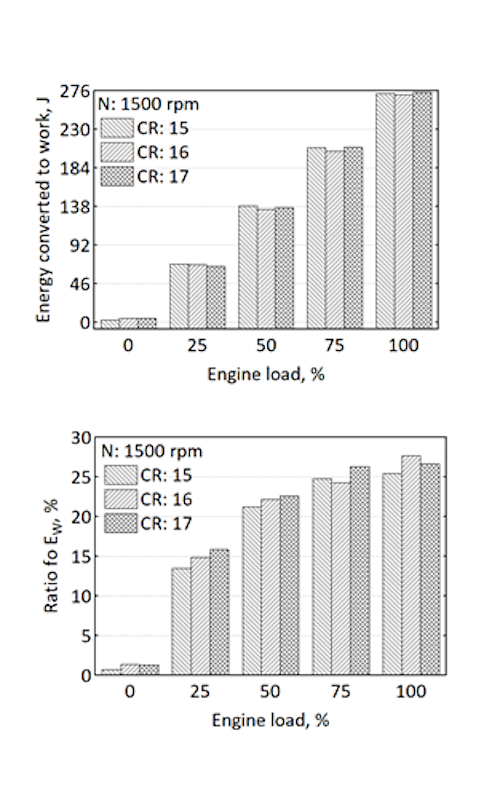
This study investigates experimentally effects of compression ratio (CR) on the combustion, energy, and exergy characteristics of a diesel engine. A four–stroke, naturally aspirated, water–cooled, direct–injection, single–cylinder diesel engine with variable CR capacity was employed. Experiments were conducted at a constant speed of 1500 rpm under various loads, with CRs set to 15:1, 16:1, and 17:1. The software in the experimental setup calculates the arithmetic mean of ten cycles to minimize the effects of cycle–to–cycle variations and enhance the accuracy of the results. A detailed thermodynamic analysis was carried out to examine the combustion, energy, and exergy characteristics of the tested CRs using data obtained from the experiments. The results demonstrated that CR has a significant influence on combustion, energy, and exergy characteristics. Combustion parameters such as mass burned fraction, heat release rate, cylinder pressure, and gas temperature increased with rising CR. Similarly, performance indicators including efficiency, fuel consumption, and the overall energy and exergy performance of the engine also tended to improve as CR increased. Among the tested CRs, a CR of 16 provided the most favorable exergetic outcomes. Specifically, exergy efficiency, exergy performance coefficient, and sustainability index improved by 9.9–22.1 %, 45.3–110.9 %, and by 0.6–6.9 %, respectively, depending on engine load for CR of 16.
Downloads
Metrics
Article Details

This work is licensed under a Creative Commons Attribution 4.0 International License.

Authors retain copyright and grant the journal right of first publication with the work simultaneously licensed under a Creative Commons Attribution license 4.0 that allows others to share the work with an acknowledgement of the work's authorship and initial publication in this journal.




References
A. B. Koc, M. Abdullah, Fuel Process. Technol. 109 (2013) 70 (https://doi.org/10.1016/j.fuproc.2012.09.039)
R. Beerge, S. Devarmani, Chapter 7. Diesel–Powered Engine and Agriculture in Diesel Engines–Current Challenges and Future Perspectives IntechOpen, 2024 (https://doi.org/10.5772/intechopen.110936)
L. Wargula, A. Kadirov, D. Aimukhanov, D. Ulbrich, P. Kaczmarzyk, D. Bak, B. Wieczorek, Sustainability 17 (2025) 10435 (https://doi.org/10.3390/su172310435)
H. Liu, S. Yu, T. Wang, J. Li, Y. Wang, J. Clean. Prod. 451 (2024) 141996 (https://doi.org/10.1016/j.jclepro.2024.141996)
P. J. Megía, A. J. Vizcaíno, J. A. Calles, A. Carrero, Energy Fuels 35 (2021) 16403 (https://doi.org/10.1021/acs.energyfuels.1c02501)
M. H. Bhuiyan, Z. Siddique, Int. J. Hydrog. Energy 102 (2025) 1026 (https://doi.org/10.1016/j.ijhydene.2025.01.033)
M. E. M. Soudagara, S. Shelared, D. Marghadef, P. Belkhodeh, M. Nur–E–Alami, T. S. Kiongk, S. Ramesha, A. Rajabik, H. Venuk, T. M. Y. Khanl, M. A. Mujtabam, K. Shahapurkara, M. A. Kalamo, I. M. R. Fattah, Energy Convers. Manag. 307 (2024) 118337 (https://doi.org/10.1016/j.enconman.2024.118337)
M. A. I. Malika, M. A. Kalama, M. M. Abbas, A. S. Silitonga, A. Ikram, Energy Convers. Manag. 313 (2024) 118643 (https://doi.org/10.1016/j.enconman.2024.118643)
P. C. Miles, Ö. Andersson, Int. J. Engine Res. 17(1) (2015) 6 (https://doi.org/10.1177/1468087415604754)
M. K. Allawi, Int. J. Eng. Tech. Res. 5(3) (2016) 66 (https://www.erpublication.org/published_paper/IJETR042155.pdf)
D. Lou, Y. Liu, Y. Zhang, Energies 18 (2025) 1656 (https://doi.org/10.3390/en18071656)
M. Kaplan, Int. J. Automot. Eng. Technol. 8(2) (2019) 83 (https://doi.org/10.18245/ijaet.1495032)
Ö. Can, E. Öztürk, E. Arcaklioğlu, Int. J. Automot. Sci. Technol. 5(1) (2021) 43 (https://doi.org/10.30939/ijastech..805531)
T. Grönstedt, M. Irannezhad, X. Lei, O. Thulin, A. Lundbladh, J. Eng. Gas Turbines Power 136 (2014) 31202 (https://doi.org/10.1115/1.4025727)
M. Özkan, Entropy 17 (2015) 244 (https://doi.org/10.3390/e17010244)
J. P. G. Montoya, Appl. Therm. Eng. 280(3) (2025) 128376 (https://doi.org/10.1016/j.applthermaleng.2025.128376)
https://www.apexinnovations.co.in/pdf/PSP240.pdf (03.04.2026)
K. Gupta, N. Singh, P. Goswami, A. Priyam, Int. J. Hydrog. Energy 163 (2025) 150712 (https://doi.org/10.1016/j.ijhydene.2025.150712)
R. B. Mshelia, R. Yusuf, S. Sudi, Konya J Eng Scı. 10(1) (2022) 18 (https://doi.org/10.36306/konjes.984008)
D. Erol, E. Gülcan, Int. J. Automot. Eng. Technol. 14(3) (2025) 154 (https://doi.org/10.18245/ijaet.1705733)
C. Tiwari, T. N. Verma, G. Dwivedi, P. Verma, Appl. Sci. 13 (2023) 1857 (https://doi.org/10.3390/app13031857)
M. Ünaldi, A. Uyaroglu, H. E. Gülcan, M. Ciniviz F. Aydin, Int. J. Hydrog. Energy 158 (2025) 150542 (https://doi.org/10.1016/j.ijhydene.2025.150542)
M. K. Rath, S. K. Acharya, P. P. Patnnaik, S. Roy, Int. J. Eng. 27(8) (2014) 1259 (https://www.ije.ir/article_72362_5cf5ccfabacae0fe6ee918ef6961bc99.pdf)
V. Gnanamoorthi, G. Devaradjane, J. Energy Inst. 88(1) (2015) 19 (https://doi.org/10.1016/j.joei.2014.06.001)
S. Verma, L. M. Das, S. C. Kaushik, Energy Convers. Manag. 138 (2017) 346 (https://doi.org/10.1016/j.enconman.2017.01.066)
V. Gajjar, V. Patel, Int. J. Eng. Sci. Invention 13(6) (2024) 38 (https://www.ijesi.org/papers/Vol(13)i6/D13063846.pdf)
P. Bridjesh, G. Arunkumar, Int. J. Chem. Sci. 13(2) (2015) 997
S. S. Bhatti, S. Verma, S. K. Tyagi, Therm. Sci. Eng. Prog. 9 (2019) 332 (https://doi.org/10.1016/j.tsep.2018.12.006)
H. Yaman, Process. Saf. Environ. Prot. 158 (2022) 607 (https://doi.org/10.1016/j.psep.2021.12.014)
S. G. Chaudhari, M. A. Modi, T. M. Patel, G. P. Rathod, IOSR J. Eng. 6(4) (2016) 13 (https://iosrjen.org/Papers/vol6_issue4%20(part-3)/D06431319.pdf)
M. K. Yesilyurt, Fuel 278 (2020) 118319 (https://doi.org/10.1016/j.fuel.2020.118319)
B. Wang, M. Pamminger, T. Wallner, Appl. Energy 254 (2019) 113645 (https://doi.org/10.1016/j.apenergy.2019.113645)
Z. M. Yao, Z. Q. Qian, R. Li, E. Hu, Energy 176 (2019) 991 (https://doi.org/10.1016/j.energy.2019.04.027)