Theoretical study of molecular structure, reactivity, and molecular docking of almotriptan and its metabolite
Article Sidebar
Main Article Content
Abstract
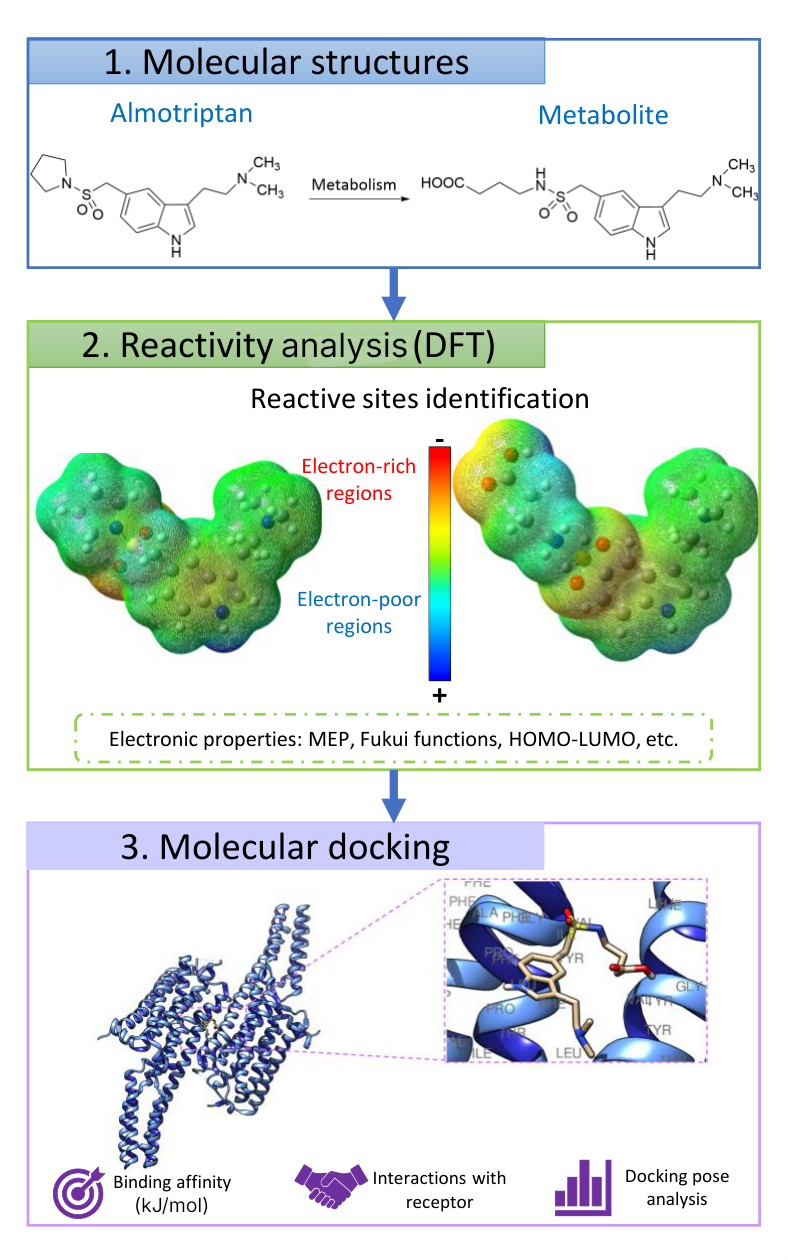
In this work, we performed a computational study of almotriptan, N,N-dimethyl-2-[5-((pyrrolidin-1-ylsulfonyl)methyl)-1H-indol-3-yl]ethanamine (denoted as Almo-I), and its metabolite, 4-(((3-(2-(dimethylamino)ethyl)-1H-indol-5-yl)methyl)sulfonamido)butanoic acid (denoted as Almo-II). Both species were examined at the X / DGDZVP level of theory (X = B3LYP, M06, M06L and ωB97XD). The reactive sites were identified through evaluation of the Fukui function using frozen-core and finite-difference approaches. For Almo-I, the sites most susceptible to nucleophilic attack are mainly located on the indole ring, whereas those prone to electrophilic attack are associated with the pyrrole double-bond region. The highest susceptibility toward radical attack was found at atoms C12, C13 and C14. In the case of Almo-II, the regions susceptible to nucleophilic attack shift from the indole ring toward the sulfonamide group, while the susceptibility to electrophilic and radical attack remains essentially unchanged. In addition, molecular docking studies showed favorable predicted interactions of Almo-I and Almo-II with the 5-HT1B receptor, with docking scores of −38.07 and −33.47 kJ mol−1, respectively. Almo-I interacted mainly with Tyr218 and Phe331 through hydrogen-bond, π–π, and van der Waals interactions, whereas Almo-II interacted with Arg236, Arg310, and Lys314 through hydrogen-bond and π-cation interactions. The more favorable docking score and binding orientation of Almo-I are consistent with its placement within the previously reported binding site. These findings contribute to a better understanding of the molecular and reactivity characteristics of almotriptan and its metabolite and may provide useful insights into its mechanism of action and drug–receptor recognition relevant to its therapeutic activity.
Downloads
Metrics
Article Details

This work is licensed under a Creative Commons Attribution 4.0 International License.

Authors retain copyright and grant the journal right of first publication with the work simultaneously licensed under a Creative Commons Attribution license 4.0 that allows others to share the work with an acknowledgement of the work's authorship and initial publication in this journal.




Funding data
-
Secretaría de Ciencia, Humanidades, Tecnología e Innovación
-
Universidad Autónoma del Estado de Hidalgo
Grant numbers PAO-2022-1389
References
S. Akerman, P. R. Holland, P. J. Goadsby, Nat. Rev. Neurosci. 12 (2011) 570–584 (https://doi.org/10.1038/nrn3057)
F. Antonaci, I. De Cillis, M. G. Cuzzoni, M. Allena, Expert Rev. Neurother. 10 (2010) 351–364 (https://doi.org/10.1586/ern.09.160)
Y. qiang Wang, W. wei Lin, N. Wu, S. yi Wang, M. zi Chen, Z. hua Lin, X. Q. Xie, Z. wei Feng, Acta Pharmacol. Sin. 40 (2019) 1138–1156 (https://doi.org/10.1038/s41401-019-0217-9)
G. Sandrini, A. Perrotta, N. L. Arce Leal, S. Buscone, G. Nappi, Neuropsychiatr. Dis. Treat. 3 (2007) 799–809 (https://doi.org/10.2147/ndt.s487)
J. Galván, V. M. Marcos, J. P. Gómez, J. M. L. Andrés, R. L. Muiño, F. T. Albareda, Neurologia 18 (2003) 7–17
S. Yella, G. Krishna Murthy Talasila, S. Rao Avanapu, Der Pharmacia Lettre 8 (2016) 84–94 (https://www.scholarsresearchlibrary.com/articles/effect-of-various-excipients-on-drug-release-of-almotriptan-orodispersible-tablets.pdf)
J. Gras, J. Llenas, J. M. Jansat, J. Jáuregui, X. Cabarrocas, J. M. Palacios, CNS Drug Rev. 8 (2002) 217–234 (https://doi.org/10.1111/j.1527-3458.2002.tb00226.x)
B. Saibaba, C. H. Vishnuvardhan, P. Johnsi Rani, N. Satheesh Kumar, J. Chromatogr. Sci. 56 (2018) 13–24 (https://doi.org/10.1093/chromsci/bmx074)
M. K. Chaudhary, A. Srivastava, K. K. Singh, P. Tandon, B. D. Joshi, Comput. Theor. Chem. 1191 (2020) 113031 (https://doi.org/10.1016/j.comptc.2020.113031)
W. López-Orozco, C. H. R. Reyes, L. H. M. Huizar, J. Serbian Chem. Soc. 85 (2020) 1291–1301 (https://doi.org/10.2298/JSC191229025L)
I. Wood, M. Pickholz, Eur. Biophys. J. 42 (2013) 833–841. (https://doi.org/10.1007/s00249-013-0932-y)
M. J. Marmura, S. D. Silberstein, T. J. Schwedt, Headache 55 (2015) 3–20 (https://doi.org/10.1111/head.12499)
R. G. Parr, R. A. Donnelly, M. Levy, W. E. Palke, J. Chem. Phys. 68 (1977) 3801–3807 (https://doi.org/10.1063/1.436185)
R. G. Parr, R. G. Pearson, J. Am. Chem. Soc. 105 (1983) 7512–7516 (https://doi.org/10.1021/ja00364a005)
R. G. Pearson, J. Chem. Educ. 64 (1987) 561–567 (https://doi.org/10.1021/ed064p561)
J. L. Gázquez, J. Mex. Chem. Soc. 52 (2008) 3–10 (https://www.jmcs.org.mx/index.php/jmcs/article/view/1040/851)
P. Geerlings, F. De Proft, W. Langenaeker, Chem. Rev. 103 (2003) 1793–1873 (https://doi.org/10.1021/cr990029p)
R. G. Parr, L. V. Szentpály, S. Liu, J. Am. Chem. Soc. 121 (1999) 1922–1924 (https://doi.org/10.1021/ja983494x)
P. K. Chattaraj, Chemical reactivity theory: a density functional view, Taylor & Francis Group, Boca Raton, 2009.
R. G. Parr, Density Functional Theory of Atoms and Molecules. In: K. Fukui, B. Pullman, (eds) Horizons of Quantum Chemistry. International Academy of Quantum Molecular Science, vol 3. Springer, Dordrecht (1980) pp. 5–15 (https://doi.org/10.1007/978-94-009-9027-2_2)
R. G. Parr, W. Yang, J. Am. Chem. Soc. 106 (1984) 4049–4050 (https://doi.org/10.1021/ja00326a036)
W. Yang, W. J. Mortier, J. Am. Chem. Soc. 108 (1986) 5708–5711 (https://doi.org/10.1021/ja00279a008)
N. Godbout, D. R. Salahub, J. Andzelm, E. Wimmer, Can. J. Chem. 70 (2011) 560–571 (https://doi.org/10.1139/v92-079)
K. Raghavachari, Theor. Chem. Accounts 103 (2000) 361–363 (https://doi.org/10.1007/s002149900065)
A. D. Becke, Phys. Rev. A 38 (1988) 3098 (https://doi.org/10.1103/PhysRevA.38.3098)
Y. Zhao, D. G. Truhlar, Theor. Chem. Acc. 120 (2008) 215–241 (https://doi.org/10.1007/s00214-007-0310-x)
Y. Wang, X. Jin, H. S. Yu, D. G. Truhlar, X. He, Proc. Natl. Acad. Sci. USA 114 (2017) 8487–8492 (https://doi.org/10.1073/pnas.1705670114)
J. Da Chai, M. Head-Gordon, Phys. Chem. Chem. Phys. 10 (2008) 6615–6620 (https://doi.org/10.1039/B810189B)
S. Miertus̃, J. Tomasi, Chem. Phys. 65 (1982) 239–245 (https://doi.org/10.1016/0301-0104(81)85090-2)
H. B. et al. Frisch, Michael J.; Trucks, George W.; Schlegel, Gaussian 09, Revision D.01, Wallingford, CT, 2013.
R. Dennington, T. A. Keith, J. M. Millam, GaussView 6.0, Semichem Inc., Shawnee Mission, 2016.
M. A. Thompson, ArgusLab 4.0.1, Planaria Software LLC, Seattle, WA, 2004.
A. Allouche, J. Comput. Chem. 32 (2012) 174–182 (https://doi.org/10.1002/jcc.21600)
T. Lu, F. Chen, J. Comput. Chem. 33 (2012) 580–592 (https://doi.org/10.1002/jcc.22885)
A. Grosdidier, V. Zoete, O. Michielin, J. Comput. Chem. 32 (2011) 2149–2159 (https://doi.org/10.1002/jcc.21797)
E. F. Pettersen, T. D. Goddard, C. C. Huang, G. S. Couch, D. M. Greenblatt, E. C. Meng, T. E. Ferrin, J. Comput. Chem. 25 (2004) 1605–1612 (https://doi.org/10.1002/jcc.20084)
D. S. BIOVIA, Discovery Studio Visualizer, Dassault Systèmes, 2019.
E. R. Johnson, S. Keinan, P. Mori-Sánchez, J. Contreras-García, A. J. Cohen, W. Yang, J. Am. Chem. Soc. 132 (2010) 6498–6506 (https://doi.org/10.1021/ja100936w)
M. E. Popović, V. Tadić, M. Popović, Virology 603 (2025) 110319 (https://doi.org/10.1016/j.virol.2024.110319)
V. A. Adediwura, K. Koirala, H. N. Do, J. Wang, Y. Miao, Expert Opin. Drug Discov. 19 (2024) 671–682 (https://doi.org/10.1080/17460441.2024.2349149).