Antistatic properties of dicarboxylic acid esters
Article Sidebar
Main Article Content
Abstract
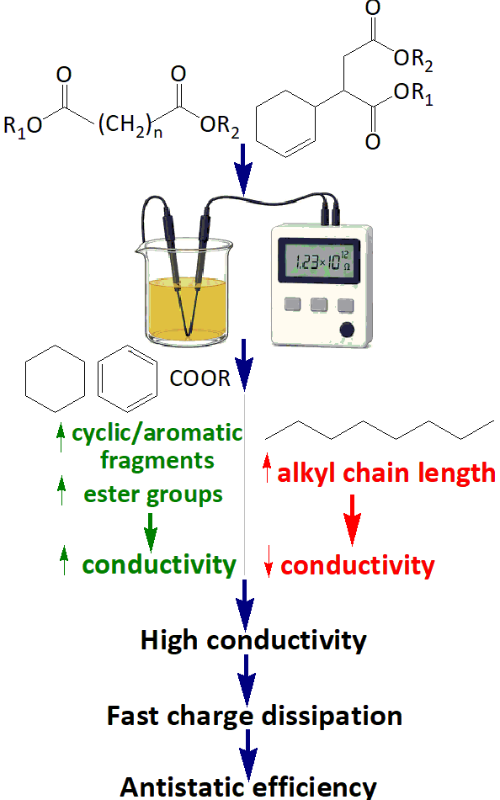
In the present study, the electrophysical properties of dicarboxylic acid esters and cyclohexenylsuccinic acid esters were investigated. Surface resistivity and electrical conductivity were measured using a two-electrode method with a teraohmmeter (E6-13A). The relationship between molecular structure and electrical conductivity were established. It was shown that an increase in the hydrocarbon chain length in both the alcohol and acid fragments leads to a decrease in electrical conductivity due to reduced molecular polarity. In contrast, the introduction of cyclic and aromatic fragments, as well as an increase in the number of ester functional groups, results in an increase in electrical conductivity due to higher molecular polarizability. Based on the experimental data, the charge relaxation time (τ) and conductivity enhancement factor (K) were calculated, enabling a quantitative assessment of the antistatic efficiency of the investigated compounds. For the dicarboxylic acid esters, τ values ranged from 4.4 × 10⁻⁵ to 8.6 × 10⁻³ s, while K varied from 2.5×10² to 7.1 × 10⁴. For cyclohexenylsuccinic acid esters, τ was found in the range of 4.6 × 10⁻⁵ to 6.5 × 10⁻⁴ s, and K ranged from 4.8 × 10³ to 6.7 × 10⁴. The obtained results indicate efficient dissipation of electrostatic charge in low-polarity hydrocarbon media. An inverse relationship between electrical conductivity and charge relaxation time was observed, confirming that higher conductivity corresponds to faster charge decay. The conductivity values are comparable with those of commercial antistatic additives, indicating the potential applicability of the investigated compounds as functional antistatic additives for petroleum and lubricating systems.
Downloads
Metrics
Article Details

This work is licensed under a Creative Commons Attribution 4.0 International License.

Authors retain copyright and grant the journal right of first publication with the work simultaneously licensed under a Creative Commons Attribution license 4.0 that allows others to share the work with an acknowledgement of the work's authorship and initial publication in this journal.




References
X. Li, L. Zhang, Y. Feng, H. Hu, X. Wang, Y. Zheng, N. Wang, Ch. Zhang, Q. Yu, F. Zhou, D. Wang, Nano Energy 104 (2022) 107930 (https://doi.org/10.1016/j.nanoen.2022.107930)
P.A. Khlyupin, R.T. Khazieva, A. Vahedi, SOCAR Proceedings. 1 (2021) 125 (http://dx.doi.org/10.5510/OGP2021SI100516)
Y. Seki, N. Yıldız, M. İnce, S. Şengül, K. Sever, M. Sarıkanat, T. Dikici, Plast. Rubb. Comp.: Macromol. Eng. 45 (2016) 362 (https://doi.org/10.1080/14658011.2016.1201258)
J. Staudt, J. Duchowski, S. Leyer, Tribol. Trans. 63 (2020) 393 (https://doi.org/10.1080/10402004.2019.1690084)
X. Zhao , Y. Zhou, J. Zhao, Zh. Guo, Y. Peng, Chem. Eng. Tran. 55 (2016) 223 (https://doi.org/10.3303/CET1655038)
X. Liang, Y. Bin, Z. Jie, WIPO Pat. WO2017096680A1 (2015)
S. Kosiński, I. Rykowska, M. Gonsior, Piotr Krzyżanowski, Polymer Testing 112 (2022) 107649 (https://doi.org/10.1016/j.polymertesting.2022.107649)
M. A. Mamedyarov, F. Kh. Aliyeva, G. N. Gurbanov, Sinteticheskie smazochnye masla (struktura i svoystva) [Synthetic Lubricating Oils (Structure and Properties)], Nauchnyi Mir, Moscow, Russia, 2017. ISBN 978-5-91522-442-0 (in Russian)
P. A. Yudaev, B. Tamboura, E. M. Chistyakov, Nanotech. construct. 15 (2023) 139 (https://doi.org/10.15828/2075-8545-2023-15-2-139-151)
O. V. Repina, S. V. Tarazanov, P. A. Nikulshin, Petrol. Chem. 63 (2023) 1009 (https://doi.org/10.1134/S0965544123060166)
A. Tsurumaki, S. Tajima, T. Iwata, B. Scrosati, H. Ohno, Electrochim. Acta 248 (2017) 556 (https://doi.org/10.1016/j.electacta.2017.07.181)
International Standard IEC 61340-6-1: Electrostatic control in healthcare environments – Material classification based on resistive properties, The International Electrotechnical Commission (2018)
ASTM D257-14: Standard Test Methods for DC Resistance or Conductance of Insulating Materials (2021)
A. C. Sparavigna, Available at SSRN(2016) 1 (http://dx.doi.org/10.2139/ssrn.2833724)
Sz. Kosiński, I. Rykowska, M. Gonsior, P. Krzyżanowski, Polymer Testing 112 (2022) 107649 (https://doi.org/10.1016/j.polymertesting.2022.107649)
Y. Liu, S. Lu, J. Luo, Y. Zhao, J. He, Ch. Liu, Z. Chen, X. Yu, Polym. Adv. Technol. 34 (2023) 1393 (https://doi.org/10.1002/pat.5978)
Y. Qiu, C. Wang, Ch. Zhao, G. Yao, Zh. Wang, R. Yang, Materials 17 (2024) 1183 (https://doi.org/10.3390/ma17051183)
A. Yadav, M. Chakradhar, A. Chopra, J. Christopher, G. Kapur, Energy & Fuels 32 (2018) 1336 (https://doi.org/10.1021/acs.energyfuels.7b03341)
M. A. Mamedyarov, F. Kh. Aliyeva, K. O. Israfilova, Oil Ref. Petrochem. 11 (2019) 20 (https://www.elibrary.ru/download/elibrary_41716270_93267800.pdf)
M. A. Mammadyarov, F. Kh. Aliyeva, S. G. Aliyeva, K. O. Israfilova, E. M. Kuliyeva, Proc. Petrochem. Oil Ref. 21 (2020) 334 (https://ppor.az/jpdf/6-Mammadyarov-3-2020.pdf).