
The industrial application of MIP-DCR technology in catalytic cracking units
Article Sidebar
Main Article Content
Abstract
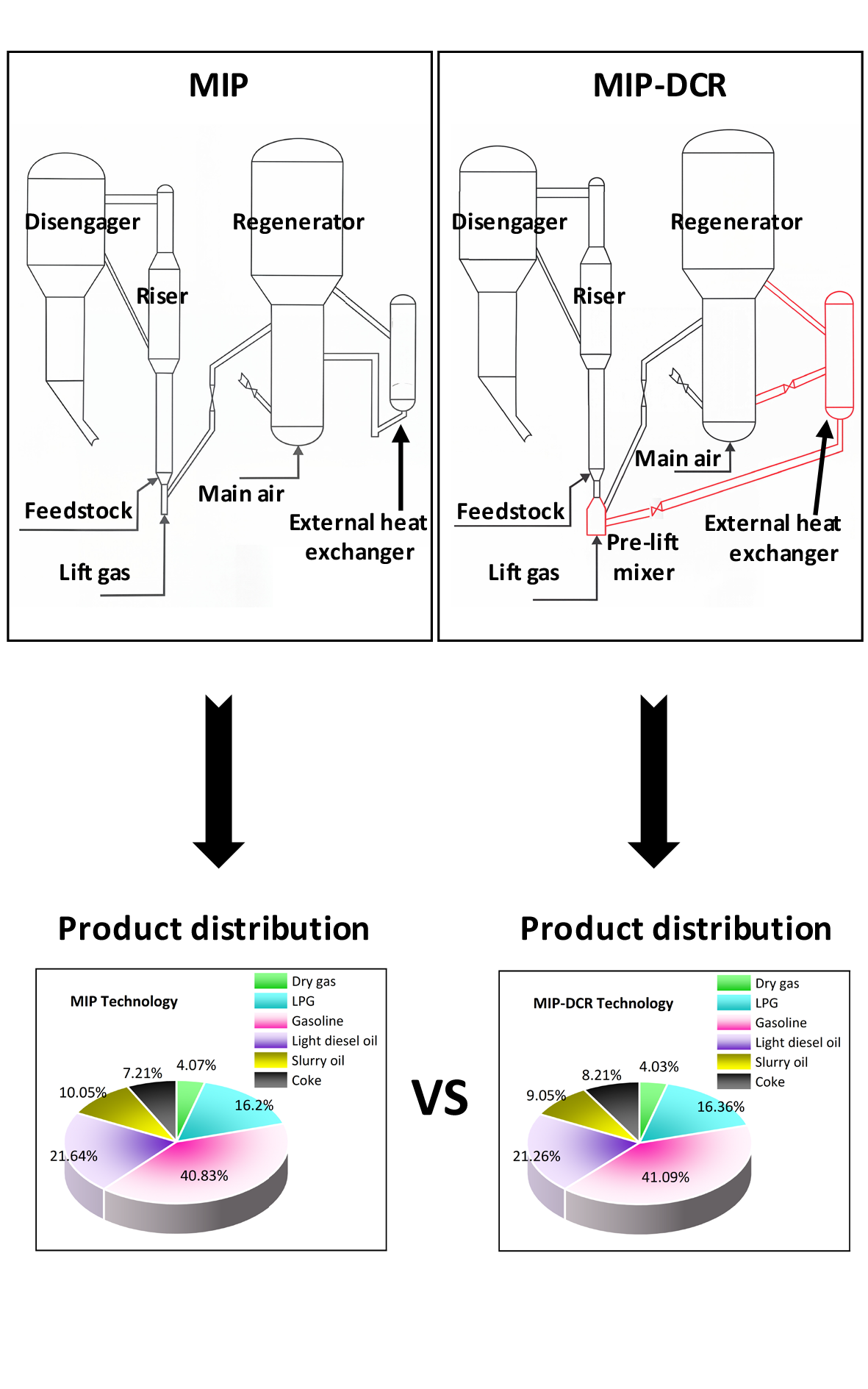
To reduce dry gas and coke yields and further optimize product distribution, an industrial trial of the MIP-DCR technology was conducted on a 2.10 Mt/a fluid catalytic cracking (FCC) unit of a Sinopec subsidiary. The results show that under conditions of identical catalyst and generally comparable overall operating parameters. At the same time, the Conradson carbon residue (CCR) of the feedstock for MIP-DCR was markedly higher than that for the conventional MIP process. Compared with the MIP operation case, the dry gas yield of MIP-DCR decreased by 0.04 percentage points; the yields of liquefied petroleum gas (LPG) and gasoline increased by 0.16 and 0.26 percentage points, respectively. The total yield of LPG, gasoline and light diesel oil rose by 0.04 percentage points, and the total yield of target liquid products remained roughly unchanged. The slurry oil yield decreased by 1.00 percentage point, whereas the coke yield increased by 1.00 percentage point. The above results basically reflect the technical characteristics of MIP-DCR in lowering dry gas yield, promoting heavy oil conversion, and optimizing product distribution, demonstrating promising potential for industrial application. Nevertheless, the impacts of increased coke yield and the difference in feedstock Conradson carbon residue on overall economic benefits still require comprehensive evaluation combined with long-term operational data.
Downloads
Metrics
Article Details

This work is licensed under a Creative Commons Attribution 4.0 International License.

Authors retain copyright and grant the journal right of first publication with the work simultaneously licensed under a Creative Commons Attribution license 4.0 that allows others to share the work with an acknowledgement of the work's authorship and initial publication in this journal.




References
S. M. Sadrameli, Fuel 173(2016) 285 (https://doi.org/10.1016/j.fuel.2016.01.047)
A. C. Akah, E. Al-Shafei, Q. Xu, M. AlHerz, Z. S. Qureshi, M. A. Bari Siddiqui, A. Aitani, Chem. Eng. J. Adv. 23(2025) 100794 (https://doi.org/10.1016/j.ceja.2025.100794)
Y. F. Zuo, L. Ye, W.J. Yang, B. Peng, J. Zhang, X. T. Shu, Y. H. Xu, J. C. Liu, ACS Catal. 15(2025) 1576 (https://doi.org/10.1021/acscatal.4c05323)
J. H. Zhang, H. H. Shan, X. B. Chen, C. Y. Li, C. H. Yang, Ind. Eng. Chem. Res. 52(2013) 6366 (https://doi.org/10.1021/ie4005496)
G. Caeiro, R.H. Carvalho, X. Wang, M.A.N.D.A. Lemos, F. Lemos, M. Guisnet, F. Ramôa Ribeiro, J. Mol. Catal. A: Chem. 255(2006) 131 (https://doi.org/10.1016/j.molcata.2006.03.068)
A.F.H. Wielers, M. Vaarkamp, M.F.M. Post, J. Catal. 127(1991) 51 (https://doi.org/10.1016/0021-9517(91)90208-l)
J. H. Gong, Y. H. Xu, Z. Cai, K. Q. Xie, Pet. Process. Petrochem. 44(2013) 6 (https://doi.org/10.3969/j.issn.1005-2399.2013.03.002)
L. G. Qiao, Pet. Refin. Eng. 45(2015) 7 (https://doi.org/10.3969/j.issn.1002-106X.2015.06.002)
C. X. Han, Y. H. Xu, B. Lu, W. Wang, Chem. Ing. Tech. 95(2023) 97 (https://doi.org/10.1002/cite.202200120)
W. J. Yang, Y. H. Xu, X. T. Shu, X. Wang, X. H. Bai, Y. F. Zuo, Y. Ouyang, Appl. Energy 349(2023) 121665 (https://doi.org/10.1016/j.apenergy.2023.121665)
J. S. Gao, C. M. Xu, Pet. Sci. Technol. 17(1999) 471 (https://doi.org/10.1080/10916469908949729)