Impact of drying, freezing and re-wetting events soil leachate in acidic versus calcareous soils Scientific paper
Article Sidebar
Main Article Content
Abstract
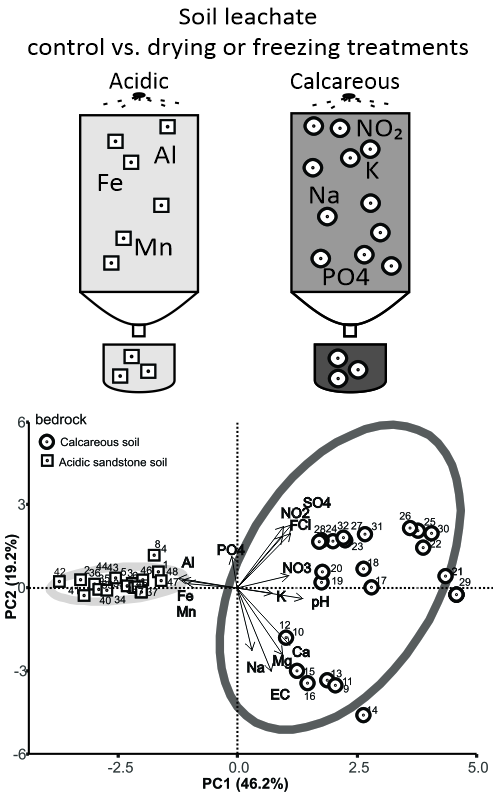
This study investigates the impact of drying-rewetting and freezing-rewetting events on soil leachate ion composition across two contrasting geochemical settings through a series of controlled laboratory experiments. Dissolution of ions (Na+, K+, Ca2+, Mg2+, Al3+, Fe3+, Mn2+, F-, Cl-, NO2-, SO42-, NO3-, PO43-) in soil leachate was analysed following rewetting cycles after drying and freezing treatments. The results indicate that variations in leachate ion concentrations are primarily influenced by bedrock type, while drying-rewetting and freezing-rewetting treatments did not significantly impact overall variance. However, some inconsistent differences were observed: higher K+ concentrations in calcareous soils and Al3+, Fe3+ and Mn2+ in acidic soils after drying, higher anion concentrations in calcareous soils in both treatment leachates compared to controls. The findings highlight that the effects of drying, freezing, and rewetting are inherently linked to treatment type, ion characteristics and geochemical conditions.
Downloads
Metrics
Article Details

This work is licensed under a Creative Commons Attribution 4.0 International License.

Authors retain copyright and grant the journal right of first publication with the work simultaneously licensed under a Creative Commons Attribution license 4.0 that allows others to share the work with an acknowledgement of the work's authorship and initial publication in this journal.




References
W. de Vries, G.J. Reinds, E. Vel, For. Ecol. Manage. 174 (2003) 97 (https://doi.org/10.1016/S0378-1127(02)00030-0)
P. S. J. Verburg, Biol. Fertil. Soils 41 (2005) 257 (https://doi.org/10.1007/s00374-005-0831-1)
J. D. Joslin, M. H. Wolfe, Can. J. For. Res. 23 (1993) 756 (https://doi.org/10.1139/x93-099)
Y. Cheng, P. G. Xu, Z. Li, T. Wang, S. Cheng, H. Zhang, T. Ma, Catena 166 (2018) 21(https://doi.org/10.1016/j.catena.2018.03.015)
E. Kaštovská, M. Choma, P. Čapek, J. Kaňa, K. Tahovská, J. Kopáček, PLoS ONE 17 (2022) e0272143 (https://doi.org/10.1371/journal.pone.0272143)
H. Hrvatović, Geological guide through Bosnia and Herzegovina, Academy of Sciences and Arts of Bosnia and Herzegovina, Sarajevo, 2022 (in Bosnian)
Federal Agropedological Institute, , https://agropedologija.gov.ba/pedoloska-karta-bosne-i-hercegovine (September 20th, 2023)
M. Ćirić, in Proceedings of the Faculty of Forestry and Institute of Forestry in Sarajevo 10 (1966) 1 (in Bosnian)
R. Jovanović, M. Mojićević, S. Tokić, Lj. Rokić, Basic geological map 1:100,000. Explanatory notes for sheet Sarajevo K 34-I, Sarajevo, 1978
J. P. Schültz, M. Saniga, J. Diaci, T. Vrška, Ann. For. Sci. 73 (2016) 911 (https://doi.org/10.1007/s13595-016-0579-9)
R. Seidl, M. J. Schelhaas, W. Rammer, P. J. Verkerk, Nature Clim. Change 4 (2014) 806 (https://doi.org/10.1038/nclimate2318)
Federal Institute of Geology, https://fzzg.gov.ba (September 20th 2023)
IUSS Working Group World Reference Base for Soil Resources (WRB), International soil classification system for naming soils and creating legends for soil maps. International Union of Soil Sciences (IUSS), Vienna, 2022 (https://www.isric.org/sites/default/files/WRB_fourth_edition_2022-12-18.pdf)
ISO 1069: Soil quality – Determination of carbonate content - Volumetric method, 1995
ISO 14235: Soil quality – Determination of organic carbon by sulfochromic oxidation, 1998
ISO 11261: Soil quality – Determination of total nitrogen - Modified Kjeldahl method, 1995
A. Kassambara, PCA: Principal component analysis (version 0.3.2), CRAN, 2020 (https://cran.r-project.org/package=PCA)
RStudio Team, RStudio: Integrated development environment for R (version 4.3.1), RStudio, PBC, 2023 (https://www.rstudio.com/)
H. P. Blume, G. W. Brümmer, H. Fleige, R. Horn, E. Kandeler, I. Kögel-Knabner, R. Kretzschmar, K. Stahr, B. M. Wilke, Scheffer/Schachtschabel Soil Science, Springer-Verlag, Heidelberg, 2016 (https://doi.org/10.1007/978-3-642-30942-7)
S. R. Olsen, F. S. Watanabe, Soil Sci. Soc. Am. Proc. 27 (1963) 648 (https://doi.org/10.2136/sssaj1963.03615995002700060024x)
H. D. Scott, R. F. Paetzold, Soil Sci. Soc. Am. J. 42 (1978) 23 (https://doi.org/10.2136/sssaj1978.03615995004200010006x)
S.U. Khan, Soil nutrients mobilization as influenced by climate-change driven soil drying–rewetting or drying–flooding, School of Engineering and the Environment, Faculty of Science, Engineering and Computing, Kingston University, London, 2020
D. Gao, E. Bai, M. Li, C. Zhao, K. Yu, F. Hagedorn, Soil Biol. Biochem. 148 (2020) 107896 (https://doi.org/10.1016/j.soilbio.2020.107896)
D. Brödlin, K. Kaiser, F. Hagedorn, Front. For. Glob. Change, Sec. Forest Soils 2 (2019) 00066 (https://doi.org/10.3389/ffgc.2019.00066)
L. K. Heng, R. E. White, N. S. Bolan, D. R. Scotter, N. Z. J. Agric. Res. 34 (1991) 325 (https://doi.org/10.1080/00288233.1991.10417672)
K. Fujii, T. Ohmiya, Catena 206 (2021) 105490 (https://doi.org/10.1016/j.catena.2021.105490)
M. Preda, M. E. Cox, Environ. Geol. 39 (2000) 319 (https://doi.org/10.1007/s002540050011)
B. E. Schaff, E. O. Skogley, Soil Sci. Soc. Am. J. 46 (1982) 521 (https://doi.org/10.2136/sssaj1982.03615995004600030015x)
M. Bradová, V. Tejnecky, L. Borůvka, K. Němeček, C. Ash, O. Šebek, M. Svoboda, J. Zenáhlíková, O. Drábek, Environ. Sci. Pollut. Res. 22 (2015) 16676 (https://doi.org/10.1007/s11356-015-4855-2).