Dioleate and trioleate epoxides from palm oil as anticancer agents through in vitro and molecular docking studies Short communication
Article Sidebar
Main Article Content
Abstract
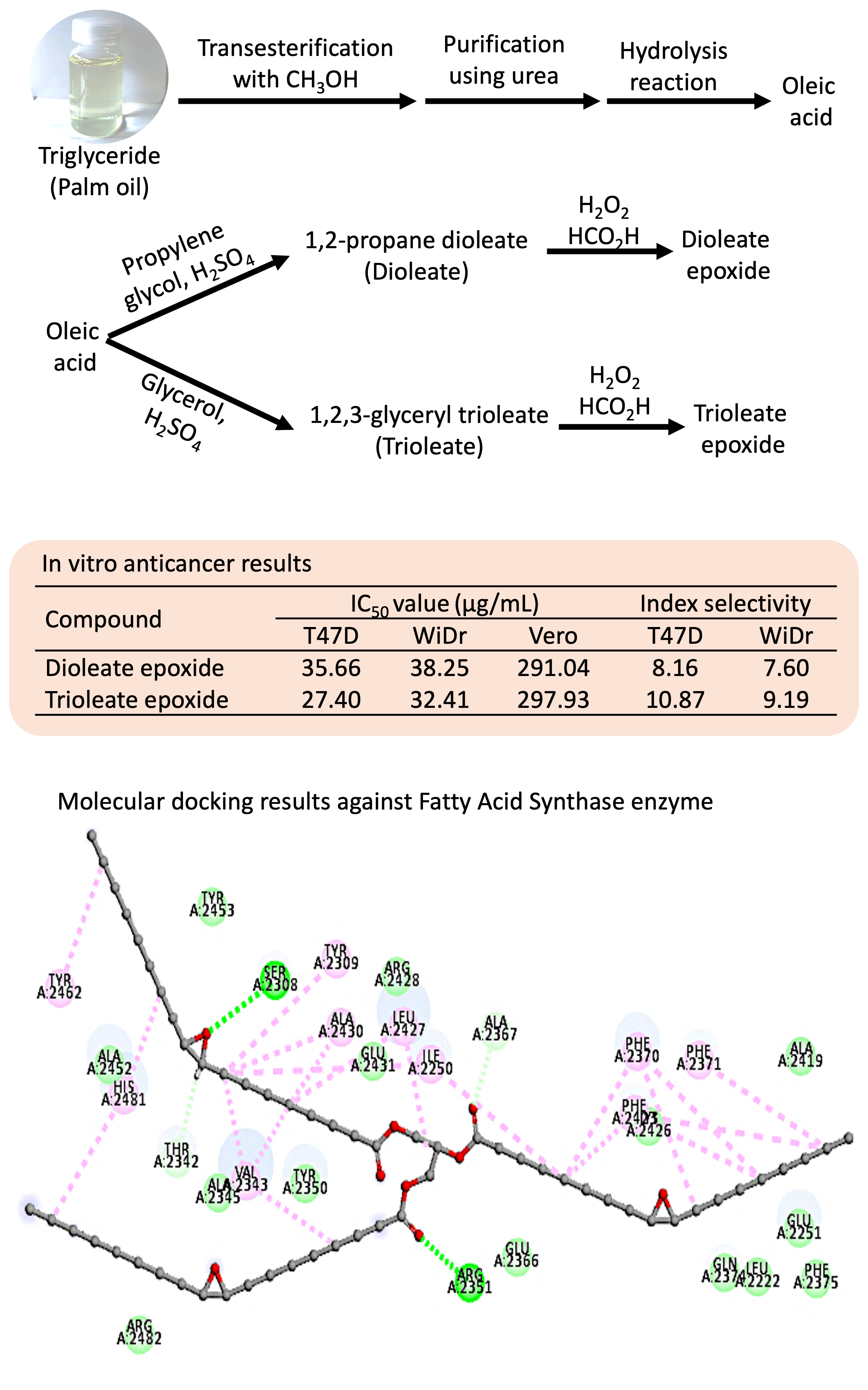
Dioleate and trioleate epoxides were successfully obtained from palm oil through several steps and evaluated as anticancer agent potential via in vitro assays and studies of their binding to the FASN protein. At first, fatty acid methyl esters (FAMEs) were isolated through the transesterification reaction from palm oil. Next, the methyl oleate from FAME was purified through urea inclusion method and then hydrolyzed into oleic acid. The oleic acid was further reacted with 1,2-propanediol and glycerol to produce 1,2-propanеdiol dioleate (dioleate) and glyceryl-1,2,3-trioleate (trioleate) derivatives, respectively. The dioleate and trioleate compounds were epoxidized with performic acid reagent to yield dioleate and trioleate epoxides, respectively. Trioleate epoxide generated a more potent anticancer activity against T47D and WiDr cancer cells with IC50 values of 27.40 and 32.41 mg L-1, respectively. In comparison, the IC50 values of dioleate epoxide against T47D and WiDr cancer cells are 35.66 and 38.25 mg L-1. Trioleate epoxide and dioleate epoxide were non-toxic for normal cells with selectivity index values of 9.19–10.87 and 7.60–8.16, respectively. The molecular docking showed that dioleate and trioleate epoxides could inhibit the function of the FASN enzyme with binding affinity values of -27.11 and -27.61 kJ mol-1, respectively.
Downloads
Metrics
Article Details

This work is licensed under a Creative Commons Attribution 4.0 International License.

Authors retain copyright and grant the journal right of first publication with the work simultaneously licensed under a Creative Commons Attribution license 4.0 that allows others to share the work with an acknowledgement of the work's authorship and initial publication in this journal.




References
F. Bray, M. Laversanne, H. Sung, J. Ferlay, R. L. Siegel, I. Soerjomataram, A. Jemal, CA Cancer J. Clin. 74 (2024) 229 (https://doi.org/10.3322/caac.21834)
P. Marino, M. Mininni, G. Deiana, G. Marino, R. Divella, I. Bochicchio, A. Giuliano, S. Lapadula, A. R. Lettini, F. Sanseverino, Nutrients 16 (2024) 800 (https://doi.org/10.3390/nu16060800)
R. Baskar, K. A. Lee, R. Yeo, K. W. Yeoh, Int. J. Med. Sci. 9 (2012) 193 (https://doi.org/10.7150/ijms.3635)
J. Cox, S. Weinman, Hepat. Oncol. 3 (2016) 57 (https://doi.org/10.2217/hep.15.41)
M. Fridlender, Y. Kapulnik, H. Koltai, Front. Plant Sci. 6 (2015) 799 (https://doi.org/10.3389/fpls.2015.00799)
A. Mancini, E. Imperlini, E. Nigro, C. Montagnese, A. Daniele, S. Orrù, P. Buono, Molecules 20 (2015) 17339 (https://doi.org/10.3390/molecules200917339)
D. Perdana, M. N. Rohman, M. Choifin, Int. J. Appl. Power Eng. 14 (2025) 980 (https://doi.org/10.11591/ijape.v14.i4.pp980-987)
K. A. Sampaio, R. Ceriani, S. M. Silva, T. Taham, A. J. A. Meirelles, Food Bioprod. Process. 89 (2011) 383 (https://doi.org/10.1016/j.fbp.2010.11.012)
J. Selvaraj, Fatty Acids and Their Analogues as Anticancer Agents, in Fatty Acids, Ed. A. Catala, InTechOpen, (2017) (https://doi.org/10.5772/intechopen.68171)
B. R. Moser, S. C. Cermak, K. M. Doll, J. A. Kenar, B. K. Sharma, J. Am. Oil Chem. Soc. 99 (2022) 801 (https://doi.org/10.1002/aocs.12623)
P. T. Wai, P. Jiang, Y. Shen, P. Zhang, Q. Gu, Y. Leng, RSC Adv. 9 (2019) 38119 (https://doi.org/10.1039/C9RA05943A)
B. R. Fatmayanti, J. Jumina, B. Purwono, Y. S. Kurniawan, H. D. Pranowo, E. N. Sholikhah, ChemistrySelect 9 (2024) 202400752 (https://doi.org/10.1002/slct.202400752)
V. M. Dembitsky, Biomedicines 11 (2023) 2237 (https://doi.org/10.3390/biomedicines11082237)
A. Lewinska, P. Chochrek, K. Smolag, E. Rawska, M. Wnuk, Redox Report 20 (2015) 116 (https://doi.org/10.1179/1351000214Y.0000000113)
C. W. Fhu, A. Ali, Molecules 25 (2020) 3935 (https://doi.org/10.3390/molecules25173935)
J. A. Menendez, E. Cuyàs, J. A. Encinar, T. Vander Steen, S. Verdura, À. Llop-Hernández, J. López, E. Serrano-Hervás, S. Osuna, B. Martin-Castillo, R. Lupu, Mol. Oncol. 18 (2024) 479 (https://doi.org/10.1002/1878-0261.13582)
R. Flavin, S. Peluso, P. L. Nguyen, M. Loda, Future Oncology 6 (2010) 551 (https://doi.org/10.2217/fon.10.11)
D. Singh, P. Patidar, A. Ganesh, S. Mahajani, Ind. Eng. Chem. Res. 52 (2013) 14776 (https://doi.org/10.1021/ie401636v)
I. A. Musa, Egyptian J. Petrol. 25 (2016) 21 (https://doi.org/10.1016/j.ejpe.2015.06.007)
I. M. Rizwanul Fattah, H. H. Masjuki, M. A. Kalam, M. Mofijur, M. J. Abedin, Energy Convers. Manag. 79 (2014) 265 (https://doi.org/10.1016/j.enconman.2013.12.024)
J. Liu, B. Tao, Biofuel Res. J. 9 (2022) 1617 (https://doi.org/10.18331/BRJ2022.9.2.3)
P. Charisiadis, V. G. Kontogianni, C. G. Tsiafoulis, A. G. Tzakos, M. Siskos, I. P. Gerothanassis, Molecules 19 (2014) 13643 (https://doi.org/10.3390/molecules190913643)
D. Radojčić, J. Hong, Z. S. Petrović, J. Polym. Environ. 30 (2022) 765 (https://doi.org/10.1007/s10924-021-02228-w)
L. L. T. Mai, M. M. Aung, S. A. M. Saidi, P. S. H’ng, M. Rayung, A. M. Jaafar, Polymers (Basel). 13 (2021) 2177 (https://doi.org/10.3390/polym13132177)
N. Ganot, S. Meker, L. Reytman, A. Tzubery, E. Y. Tshuva, J. Vis. Exp. 81 (2013) e50767 (https://doi.org/10.3791/50767)
T. Widiandani, T. Tandian, B. D. Zufar, A. Suryadi, B. T. Purwanto, S. Hardjono, S. Siswandono, J. Public Health Afr. 14 (2023) 2516 (https://doi.org/10.4081/jphia.2023.2516)
V. E. Fako, J. T. Zhang, J. Y. Liu, ACS Catal. 4 (2014) 3444 https://doi.org/10.1021/cs500956m
S. J. Grabowski, Ann. Rep. Prog. Chem. Sect. C 102 (2006) 131 (https://doi.org/10.1039/B417200K).