
Optimizing ethylene plant utilities via Hybrid ANN and first-principles modelling
Article Sidebar
Main Article Content
Abstract
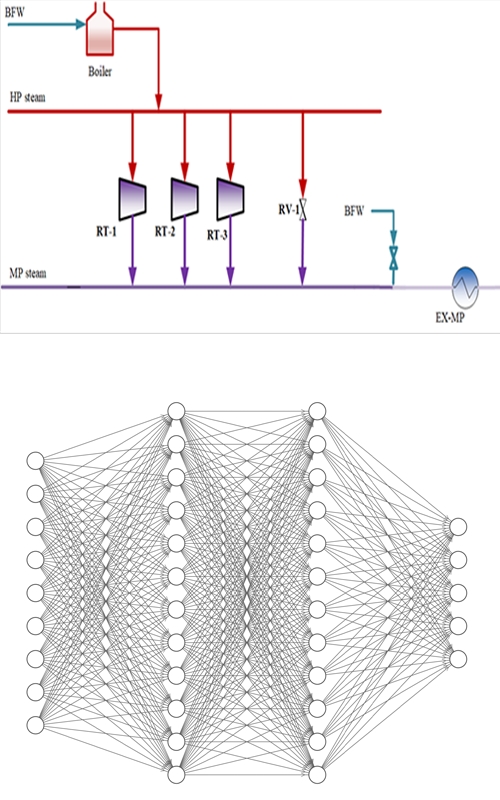
In this study, a hybrid modeling approach combining first-principles equations with an artificial neural network was developed to reduce operating costs and carbon emissions in process utility systems of ethylene plant. The artificial neural network accurately predicted turbine power outputs under various operating conditions, with low maximum absolute percentage errors across all three turbines, demonstrating its ability to effectively capture nonlinear system behavior. The economic analysis showed that natural gas prices have a greater cumulative impact on operating expenses than the carbon tax due to their greater variability. Although the carbon tax has a higher local sensitivity, the steady increase in natural gas prices represents a persistent economic burden. This demonstrates the importance of managing fuel costs and monitoring changes in carbon policy to mitigate sudden increases in operating costs. With increasing output, the operating costs of the propylene and cracked gas turbines rose almost linearly, with the costs per megawatt rising more sharply for the propylene turbine. The ethylene turbine significantly impacted operating expenses despite lower output, showing small output changes can affect costs. Overall, the proposed methodology provides a reliable framework for optimizing energy performance, predicting fuel consumption and supporting operational decision in large-scale processes.
Downloads
Metrics
Article Details

This work is licensed under a Creative Commons Attribution 4.0 International License.

Authors retain copyright and grant the journal right of first publication with the work simultaneously licensed under a Creative Commons Attribution license 4.0 that allows others to share the work with an acknowledgement of the work's authorship and initial publication in this journal.
Funding data
-
Ministarstvo Prosvete, Nauke i Tehnološkog Razvoja
Grant numbers 451-03-136/2025-03/200026;451-03-136/2025-03/200135
References
S. P. Mavromatis, A. C. Kokossis, Chem. Eng. Sci. 53 (1998) 1585 (https://doi.org/10.1016/s0009-2509(97)00431-4)
Q. Zhu, X. Luo, B. Zhang, Y. Chen, S. Mo, Energy 97 (2016) 191 (https://doi.org/10.1016/j.energy.2015.12.112)
Z. Li, W. Du, L. Zhao, F. Qian, Ind. Eng. Chem. Res. 53 (2014) 11021 (https://doi.org/10.1021/ie402438t)
Y.-M. Han, Z.-Q. Geng, Q.-X. Zhu, Energy Convers. Manag. 124 (2016) 73 (https://doi.org/10.1016/j.enconman.2016.07.002)
Y. Wang, X. Cui, D. Peters, B. Çıtmacı, A. Alnajdi, C. G. Morales-Guio, P. D. Christofides, Dig. Chem. Eng. 12 (2024) 100173 (https://doi.org/10.1016/j.dche.2024.100173)
G. Zhou, X. Li, J. Liu, D. Yu, F. Wang, J. Wan, 'Performance monitoring of steam turbine regenerative system based on extreme learning machine,' Prognostics and System Health Management Conference (2017) Harbin, China, Proceedings, pp. 1–7. (https://doi.org/10.1109/phm.2017.8079195)
M. G. R. Shuvo, N. Sultana, L. Motin, M. R. Islam, (2021) 'Prediction of Hourly Total Energy in Combined Cycle Power Plant Using Machine Learning Techniques,' 1st International Conference on Artificial Intelligence and Data Analytics (2021) Riyadh, Saudi Arabia, Proceddings, pp. 170–175. (https://doi.org/10.1109/caida51941.2021.9425308)
H. Zhao, arXiv (2020) preprint, arXiv :2002.02402.(https://doi.org/10.48550/arxiv.2002.02402)
Z. Li, L. Zhao, W. Du, F. Qian, Chin. J. Chem. Eng. 21 (2013) 520 (https://doi.org/10.1016/s1004-9541(13)60530-3)
F. Chu, F. Wang, X. Wang, S. Zhang, Neural Comput. Appl. 24 (2013) 1259 (https://doi.org/10.1007/s00521-013-1347-5)
F. Hajabdollahi, Z. Hajabdollahi, H. Hajabdollahi, Appl. Soft Comput. 12 (2012) 3648 (https://doi.org/10.1016/j.asoc.2012.06.006)
Z. Shang, A. Kokossis, Comput. Chem. Eng. 28 (2004) 1673 (https://doi.org/10.1016/j.compchemeng.2004.01.010)
F. Chollet, Keras (2015) https://keras.io