
Environmental behavioral controls of polychlorinated biphenyls: Prediction of the soil sorption coefficient (Koc) using multiple linear regression Scientific paper
Article Sidebar
Main Article Content
Abstract
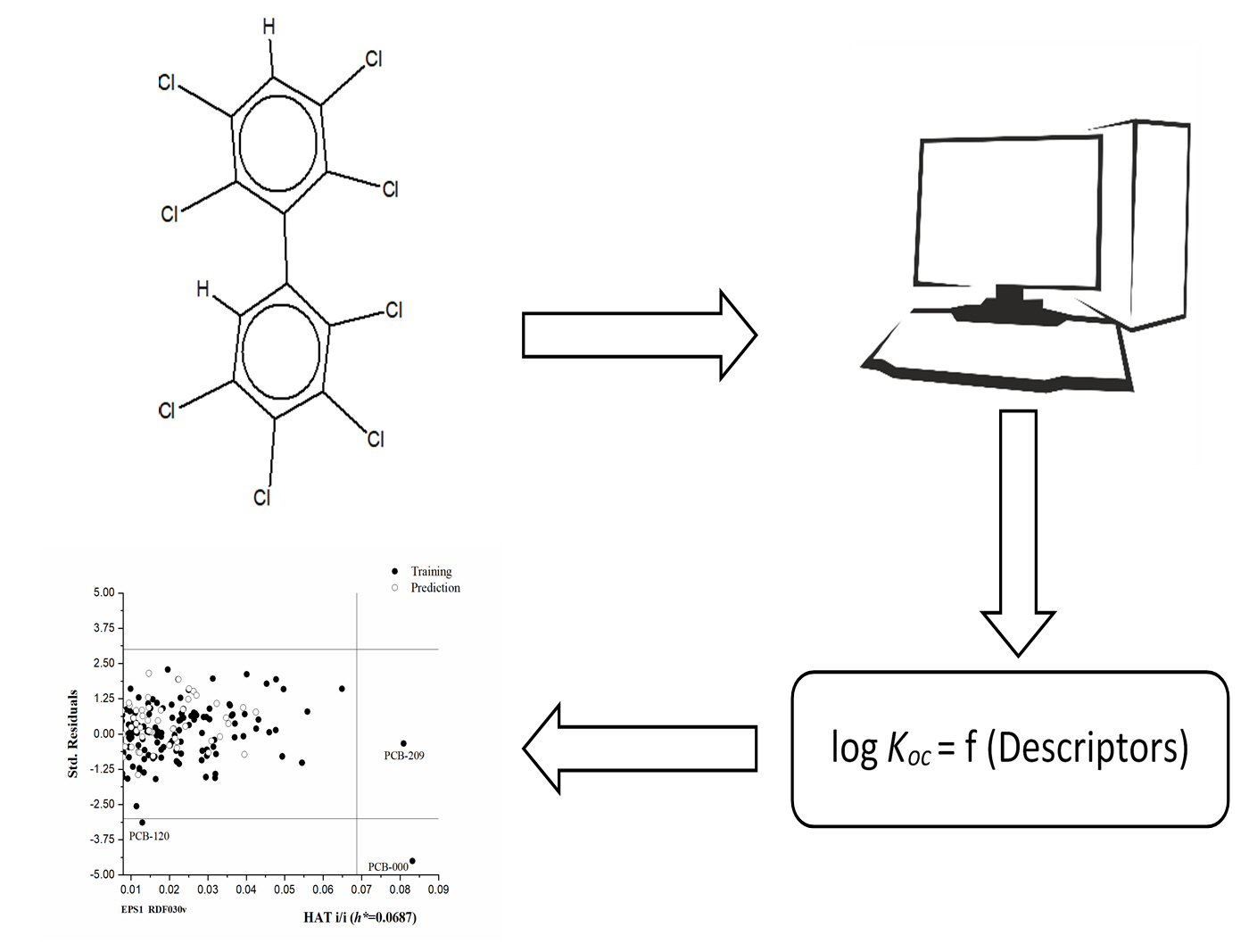
The application of the quantitative structure property relationship (QSPR) approach helps to predict physicochemical properties of chemicals from their molecular structures. They are based on the translating and encoding of input information on theoretical molecular descriptors running by genetic algorithm techniques (GAs). In this research, the focus is mainly on the controlling and understanding the environmental fate and transport mechanisms of polychlorobiphenyls (PCBs) in soils. To achieve this goal, multiple linear regression (MLR) models were handed-down on a series of 188 PCBs to predict their soil sorption coefficient (log Koc) which is critical to measuring their affinity. All statistical parameters obtained have indicated that the QSPR-MLR model has a very high predictive ability with a higher coefficient of determination (R2 = 0.9984) and lower root mean squared errors (RMSE = 0.0610). Moreover, the dominant molecular descriptors mentioned that the sorption process of these compounds on the surface of soils have been influenced by the size of molecule, polarizability and density.
Downloads
Metrics
Article Details

This work is licensed under a Creative Commons Attribution 4.0 International License.

Authors retain copyright and grant the journal right of first publication with the work simultaneously licensed under a Creative Commons Attribution license 4.0 that allows others to share the work with an acknowledgement of the work's authorship and initial publication in this journal.




References
S. Kherouf, N. Bouarra, A. Bouakkadia, D. Messadi, J. Serb. Chem. Soc. 84 (2019) 575 (https://doi.org/10.2298/JSC180820016K)
P. Gramatica, Int. J. Quant. Struct. Prop. Relat. 5 (2020) 63 (https://doi.org/10.4018/IJQSPR.20200701.oa1)
S. Yu, S. Gao, Y. Gan, Y. Zhang, X. Ruan, Y. Wang, L. Yang, J. Shi, SAR QSAR Environ. Res. 27 (2016) 2 (http://dx.doi.org/10.1080/1062936X.2016.1158734)
W. J. Doucette, Environ. Toxicol. Chem. 22 (2003) 1771 (http://doi.org/10.1897/01-362)
P. Gramatica, E. Giani, E. Papa, J. Mol. Graph. Modell. 25 (2007) 755 (https://doi.org/10.1016/j.jmgm.2006.06.005)
R. S. Kookana, R. Ahmad, A. Farenhorst, in Non-First Order Degradation and Time-Dependent Sorption of Organic Chemicals in Soil, W. Chen, A. Sabljic, S. A. Cryer, R. S. Kookana, Eds., ACS Symposium Series, Vol. 1174, American Chemical Society, Washington DC, 2014, pp. 222–236 (http://doi.org/10.1021/bk-2014-1174.ch012)
J. Yuan, S. Yu, T. Zhang, X. Yuan, Y. Cao, X. Yu, X. Yang, W. Yao, Ecotox. Environ. Safety 128 (2016) 171 (http://dx.doi.org/10.1016/j.ecoenv.2016.02.022)
Y. Wang, J. Chen, X. Yang, F. Lyakurwa, X. Li, X. Qiao, Chemosphere 119 (2015) 438 (http://dx.doi.org/10.1016/j.chemosphere.2014.07.007)
M. H. Fatemi, Z. G. Chahi, SAR QSAR Environ. Res. 23 (2012) 155 (http://dx.doi.org/10.1080/1062936X.2011.645876)
P. Singh, S. Pandit, R. Parthasarathi, in Safety Evaluation and Risk Assessment, H. Hong Ed., Elsevier Science, Amsterdam, 2023, pp. 77–87 (http://doi.org/10.1016/B978-0-443-15339-6.00026-6)
S. Mao, S. Liu, Y. Zhou, Q. An, X. Zhou, Z. Mao, Y. Wu, W. Liu, Environ. Poll. 271 (2021) 116171 (https://doi.org/10.1016/j.envpol.2020.116171)
Y. Dumanoglu, E. O. Gaga, E. Gungormus, S. C. Sofuoglu, M. Odabasi, Sci. Tot. Environ. J. 580 (2017) 920 (http://doi.org/10.1016/j.scitotenv.2016.12.040)
S. Kakareka, T. Kukharchyk, in EMEP/CORINAIR Guidebook, K. Breivik, Ed., European Environment Agency, Copenhagen, 2005 (https://www.eea.europa.eu/publications/EMEPCORINAIR5/Sources_of_PCB_emissions.pdf)
K. B. Moysich, R. J. Menzes, J. A. Baker, K. L. Falkner, Rev. Environ. Health 17 (2002) 263 (http://doi.org/10.1515/REVEH.2002.17.4.263)
D. O. Carpenter, Rev. Environ. Health 21 (2006) 1 (https://doi.org/10.1515/REVEH.2006.21.1.1)
L. M. Frazier, J. Agromed. 12 (2007) 27 (https://doi.org/10.1300/J096v12n01_04)
N. Othman, Z. Ismail, M. I. Selamat, S. H. S. Abdul Kadir, N. A. Shibraumalisi, Int. J. Environ. Res. Public Health 19 (2022) 13923 (https://doi.org/10.3390/ijerph192113923)
K. Jagiello, A. Sosnowska, S. Walker, M. Haranczyk, A. Gajewicz, T. Kawai, N. Suzuki, J. Leszczynski, T. Puzyn, Struct. Chem. 25 (2014) 997 (https://doi.org/10.1007/s11224-014-0419-1)
ChemDraw, CambridgeSoft Corporation, Cambridge, MA (http://camsoft.com/)
HyperchemTM, release 6.03 for windows, Hypercube, Inc., Gainesville, FL, 2000
R. Todeschini, V. Consonni, M. Pavan, DRAGON Software for the Calculation of Molecular Descriptors, release 5.3 for windows, Talete srl, Milano, 2006
P. Gramatica, N. Chirico, E. Papa, S. Cassani, S. Kovarich, J. Comp. Chem. 34 (2013) 2121 (https://doi.org/10.1002/jcc.23361)
P. Gramatica, S. Cassani, N. Chirico, J. Comp. Chem. 35 (2014) 1036 (https://doi.org/10.1002/jcc.23576)
L. Gu, T. Zhu, M. Chen, J. Environ. Chem. Eng. 9 (2021) 105615 (https://doi.org/10.1016/j.jece.2021.105615)
X. Zhao, Y. Zhao, Z. Ren, Y. Li, Comp. Biol. Chem. 79 (2019) 177 (http://doi.org/10.1016/j.compbiolchem.2019.02.008)
H. Yu, D. Wondrousch, F. Li, J. Chen, H. Lin, L. Ji, Chem. Res. Toxicol. 28 (2015) 1541 (http://doi.org/10.1021/acs.chemrestox.5b00127)
H. Liu, M. Wei, X. Yang, C. Yin, X. He, Sci. Total Environ. 574 (2017) 1371 (https://doi.org/10.1016/j.scitotenv.2016.08.051)
N. Chirico, P. Gramatica, J. Chem. Inf. Model. 52 (2012) 2044 (https://doi.org/10.1021/ci300084j)
E. Carnescchi, A. A. Toropov, A. P. Toropova, N. Kramer, C. Svendsen, J. L. Dorne, E. Benfenati, Sci. Total Environ. 704 (2020) 135302 (http://doi.org/10.1016/j.scitotenv.2019.135302)
T. Zhu, H. Yan, R. P. Singh, Y. Wang, H. Cheng, Env. Sci. Poll. Res. J. 27 (2020) 17550 (http://doi.org/10.1007/s11356-019-06389-z)
N. Bouarra, S. Kherouf, N. Nadji, L. Nouri, A. Boudjemaa, S. Djerad, K. Bachari, Chem. Prod. Process Model. 19 (2024) 251 (http://doi.org/10.1515/cppm-2023-0024).